



Reviewed by Dr. Sarika Arora, MD
For women, thinning hair and hair loss are serious problems that can leave you feeling socially isolated and depressed. Lots of us think, “If my hair doesn’t look good, I look bad,” but hair loss means more than just a change in your appearance. Your hair is important to how you feel about yourself, and losing it can cause anxiety, relationship problems and career-related issues.
Thinning hair means something is going wrong with your health. Along with changes to skin and nails, hair loss is one of the first signs of hormonal imbalance, poor nutrition and illness. While some hair loss is normal, it certainly isn’t an inevitable part of aging for any gender.
Topics covered in this article:
- The hair growth cycle up close
- Causes of hair loss in women
- Hormones and hair loss: menopause, PCOS, and male pattern baldness
- Immunological and infectious factors can cause hair loss
- Real-life natural hair loss solutions
- How to support healthy hair growth
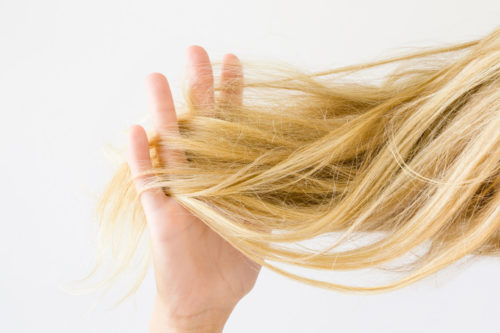
Hair loss and thinning hair are complicated issues. Understanding how hair grows and regenerates can help you find the best way to reverse hair loss where it counts: at the root.
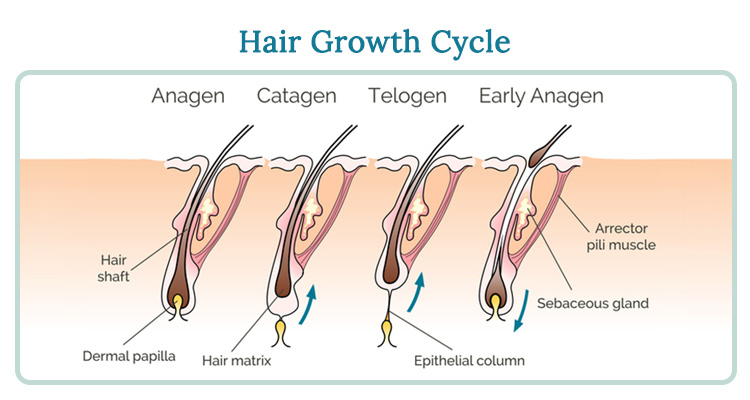
The hair growth cycle up close
Your hair is dead, or rather it’s made up of extruded, compacted dead cells. Your circulatory, endocrine, and nervous systems are all needed to grow hair. Each hair grows out of a living follicle that cycles through four distinct phases on a regular basis:
1. growth — or anagen
2. transition — or catagen
3. resting — or telogen
4. returning growth — or mesanagen
This full cycle can last from two to five years per follicle. The problem of unusual hair loss and thinning occurs when a follicle gets stuck in the telogen, or resting, phase. Bald spots appear when a large group of follicles all turn off in one place. Most of the time this occurs slowly, but in some cases it can happen all at once, causing a clump of hair to fall out.
Every day, human beings lose hair, about 50–100 strands a day. You can use our “pull test” to see if your hair loss is excessive. Take about 60 hairs between your fingers and pull gently but firmly. Normally about 5–8 hairs will come out. That means the average 10% of hair follicles are transitioning normally toward the resting phase. If more than 15 hairs come out, it may indicate unusual hair loss, or telogen effluvium.
Here’s what happens with telogen effluvium: more follicles than average move into the resting state. When this happens, you may notice more hair than usual in your hairbrush or on the bathroom floor. Women can also suddenly lose a clump of hair — or parts of their eyebrows — after a terrible shock.
Keep in mind that if your hair is dark and thick, strands on the floor may make it look like you are losing more hair than you actually are.
Causes of hair loss in women
The resting phase of hair growth is supposed to be temporary. Hair follicles can be shocked into resting by many different stressors and then can suddenly switch on again once that stress is reduced. Hair growth seems to be very adaptive, which is why scientists believe that we will find a cure for hair loss.
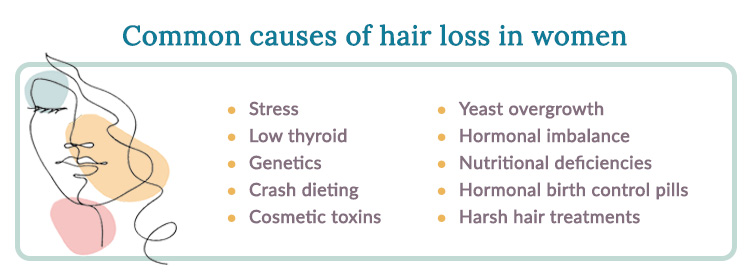
Causes of hair loss in women are frequently related to environmental exposures, lifestyle choices, medical conditions and genetics.
The complete list of factors that contribute to unusual hair loss is extensive:
- Stress, both emotional and physical
- Hormonal imbalance, especially androgen sensitivity
- Nutritional deficiencies, especially with vitamin D, vitamin A, iron and protein
- Thyroid disorders
- Change in hormonal birth control
- Genetics
- Immune system irregularities
- Yeast overgrowth or fungus
- Crash diets that lead to sudden, dramatic weight loss
- Cosmetics that you may be allergic to
- Harsh chemical treatments
- Radiation and/or chemotherapy
- Dental infections
- Blood loss
- Certain medications (including anticoagulants, anticonvulsants, some thyroid medications, and hormone therapy)
- Certain diseases
- Some surgeries
- Localized scarring
Some women see noticeable hair loss at different phases of their menstrual cycles, and sometimes even seasonally. This is very common and tends to resolve itself naturally.
Most women with moderate hair loss will see improvement by focusing on their stress levels and nutrition. Since these two factors go hand in hand, if you give your body key nutrition when you are super-stressed —especially hair-specific nutrients — you can really boost hair growth.

Some women will still need to investigate other causes by talking to their doctors about lab tests that may include hormone panels, thyroid tests, fasting insulin, metabolic panels, iron (ferritin) stores, complete blood count (CBC) or allergy testing.
Testing for insulin resistance, testosterone levels, and thyroid or other metabolic dysfunction can point to hormonal issues like androgen sensitivity, thyroid dysfunction, or an endocrine disturbance as a possible cause for thinning hair.
Hormones and hair loss: menopause, PCOS, and male pattern baldness
If you develop dramatic, localized hair thinning or even noticeable bald spots, you’re probably experiencing male pattern baldness, or androgenetic alopecia (AGA). It’s the most common form of hair loss in both men and women and almost always happens on the top and sides of the head and above the forehead. It may also involve excessive hair growth on the face and other areas on the body.
Though hair loss in women is different from that in men, there are some similarities in how hormones affect hair growth. Androgens — testosterone and DHEA— are naturally converted into DHT (dihydrotestosterone). DHT is a substance that stimulates blood flow to the hair follicle, promoting hair growth.
When the follicle’s receptors become oversensitive to androgens, they shut down. Causes include genetics, abnormally high levels of free testosterone, or a change in sensitivity to normal levels of circulating androgens. Available testosterone-blocking drugs like flutamide are generally intended for men, and are mostly ineffective in women. They don’t restore hormonal balance either.
Hormonal imbalances due to perimenopause or polycystic ovarian syndrome (PCOS) are the primary causes of male pattern baldness in women. Women with PCOS often have high levels of circulating androgens as well as insulin resistance, which highlights the connection between insulin resistance, testosterone, and hair loss. Insulin receptor resistance and sensitivity to androgens may be connected, especially if there is a genetic paternal history of hair loss.
You may have a genetic predisposition to male pattern baldness, though the same process happens in every woman to some degree as she ages and estrogen levels fall. Decreasing estrogen may allow the body to convert more available testosterone. Sometimes male pattern baldness can be resolved or limited when internal hormonal balance is restored.
Immunological and infectious factors can cause hair loss
If hair loss worsens over time, or if hair falls out, leaving patchy bald spots all over the head, it may be caused by either the autoimmune condition called alopecia areata, or the infection-induced cicatricial alopecia.
While there is no cure for alopecia areata, doctors can prescribe topical solutions and injectable steroids. Hair transplants and laser stimulation are potential options. Naturally boosting immune function can help too.
Occasionally an overgrowth of fungus or yeast can trigger severe follicular inflammation that results in hair loss. This can be diagnosed by a dermatologist after a scalp examination. Treatments vary but usually involve topical anti-fungal shampoos or solutions.

Real-life natural hair loss solutions
You already know that there isn’t a magical cure for baldness or hair loss. Doctors may recommend treating hair loss in women with off-label use of topical treatments like minoxidil that enhance existing hair. These products have serious limitations, are quite difficult to apply, and side effects are common.
Natural approaches to stopping hair loss and restoring healthy hair growth can be surprisingly effective, but you have to stick with them. For the most part, the best solutions for hair loss work inside your body, not on top of your head.
How to support healthy hair growth
- Pinpoint the biggest stressors in your life.
Take firm action to shift your lifestyle toward preventing your personal stress factors from overwhelming your body. Try meditation, mindfulness practices, exercise and spending more time outside. - Supply the nutrients your hair needs daily for healthy growth.
Look for a targeted formula with vitamins A, C, E and B7, or biotin to give hair (plus skin and fingernails) the nutrition that fuels growth. Other ingredients with good science behind them are alpha-lipoic acid, choline, silica (found in horsetail extract) and coenzyme Q 10 to support mitochondrial health within your cells. Make sure you get vitamin D daily for your hair, and your overall health. - Eat right to prevent diet-related hair loss.
Eat whole, protein-rich foods and fill three quarters of your plate with vegetables and fruits. Limit refined sugars and simple carbohydrates as much as possible to reduce inflammation and help with blood sugar balance. - Coax your body back into hormonal balance.
If you are in perimenopause or are noticing hormonal changes, consider trying a gentle endocrine support supplement to help naturally rebalance your hormones. This can help with other hormonal symptoms at the same time. - Love your scalp.
Stimulate blood flow to your scalp to help support normal follicle function. Try regular scalp massages: use your fingertips to make consistent circular, stroking movements from front to back, and then make gentle kneading and lifting movements. Acupuncture is another option.
Give these steps about six months to work before you talk to your practitioner about what you should do next. The condition of your hair mirrors what’s going on inside your body. Taking care of your health from the inside out can improve the quality and quantity of your hair, and make you feel better about yourself.
Kevin R. Brough and Rochelle R. Torgerson. Hormonal therapy in female pattern hair loss. Int J Womens Dermatol. 2017 Mar; 3(1): 53–57. Published online 2017 Feb 24. doi: 10.1016/j.ijwd.2017.01.001. https://www.ncbi.nlm.nih.gov/pmc/articles/PMC5419033/. Accessed 9.25.17.
1 Shapiro J. Clinical practice. Hair loss in women. N Engl J Med. 2007 Oct 18;357(16):1620-30.
2 Mirmirani P. How to approach hair loss in women. Dermatol Nurs. 2007 Dec;19(6):531-5.
3 Springer K, Brown M, Stulberg DL. Common Hair Loss Disorders. American Family Physician Web site. https://www.aafp.org/afp/2003/0701/p93.html. Accessed June 13, 2014.
4 Mirmirani P. How to approach hair loss in women. Dermatol Nurs. 2007 Dec;19(6):531-5.
5 Shapiro J. Clinical practice. Hair loss in women. N Engl J Med. 2007 Oct 18;357(16):1620-30.
6 Mirmirani P. How to approach hair loss in women. Dermatol Nurs. 2007 Dec;19(6):531-5.
7 Springer K, Brown M, Stulberg DL. Common Hair Loss Disorders. American Family Physician Web site. https://www.aafp.org/afp/2003/0701/p93.html. Accessed June 13, 2014.
8 Springer K, Brown M, Stulberg DL. Common Hair Loss Disorders. American Family Physician Web site. https://www.aafp.org/afp/2003/0701/p93.html. Accessed June 13, 2014.
9 Herskovitz I, Tosti A. Female Pattern Hair Loss. Int J Endocrinol Metab. 2013 Oct 21;11(4):e9860.
10 Matilainen V, Laakso M, Hirsso P, et al. Hair loss, insulin resistance, and heredity in middle-aged women. A population-based study. J Cardiovasc Risk. 2003 Jun;10(3):227-31.
11 Springer K, Brown M, Stulberg DL. Common Hair Loss Disorders. American Family Physician Web site. https://www.aafp.org/afp/2003/0701/p93.html. Accessed June 13, 2014.
12 Avram MR, Leonard RT Jr, Epstein ES, et al. The current role of laser/light sources in the treatment of male and female pattern hair loss. J Cosmet Laser Ther. 2007 Mar;9(1):27-8.
13 Hair-Raising Breakthrough. May 13, 2010. Medical Breakthroughs Reported by Ivanhoe. Ivanhoe Web site. https://ivanhoe.com/channels/p_channelstory.cfm?storyid=24105. Accessed June 13, 2014.