



What your symptoms mean — simplified


Insight #1
Your symptoms are your body’s way of asking for help
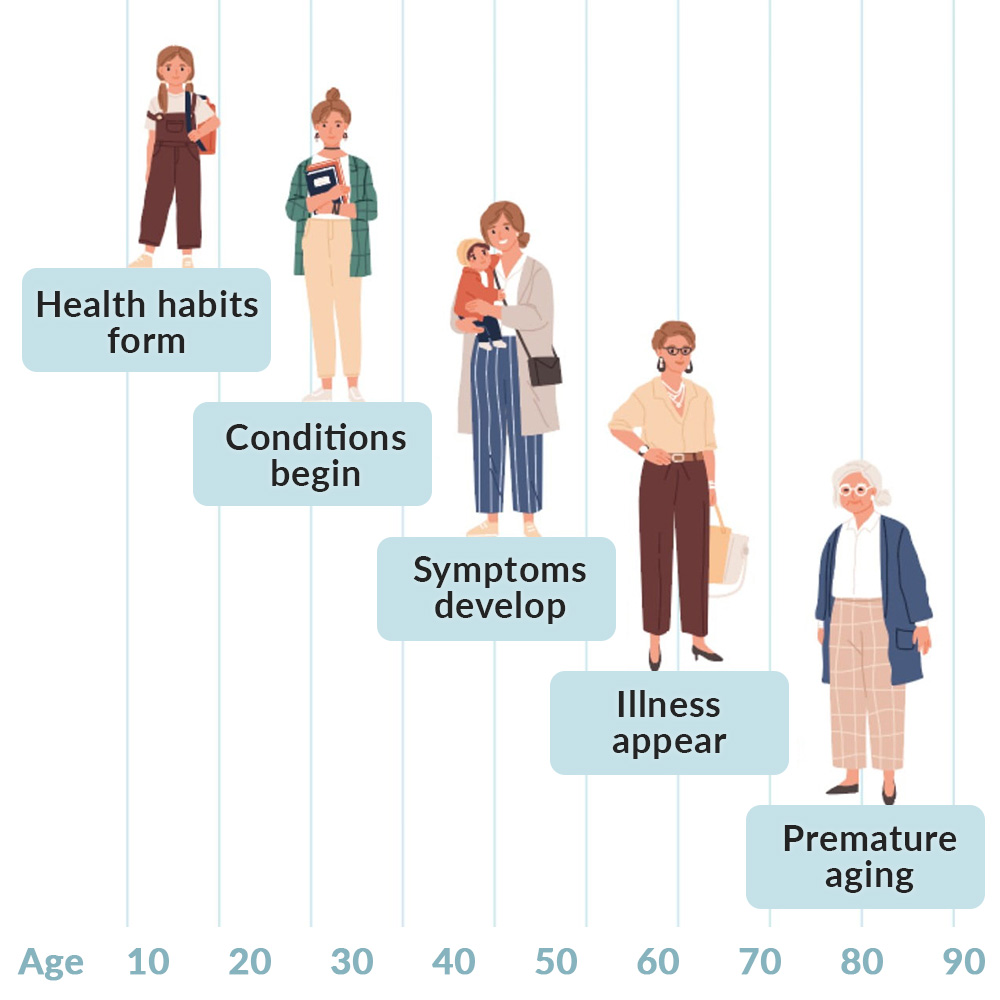
Your symptoms are signs of trouble. And the trouble started before the symptoms appeared. If you don’t do anything, the trouble almost always gets worse. Then you have a condition, and eventually, a disease. So – doing nothing is not the best idea.
How symptoms lead to illness
Insight #2
Everything is connected
Very few women are told the basic truth about how their bodies work. Start by understanding that your body is a miracle. A zillion cells organized into organs and systems, like a big symphony orchestra making beautiful music. All your body’s systems listen to one another and play together. Second by second.
Well – that’s the idea. But when you have symptoms, it isn’t beautiful music anymore. Let’s take an example.
All those systems are connected by the Vagus Nerve (see diagram). Among many other things, the Vagus Nerve regulates your “fight or flight” response. That’s how stress suppresses your immune function and your digestion. That’s also how your microbiome acts as a “second brain” – the Vagus Nerve literally connects your guts to your brain.
One big shortcoming of conventional medicine is that it tries to address women’s chronic health problems one at a time, with a focus on symptoms instead of their underlying causes. But no symptom exists in isolation.
That’s why women rarely have only one symptom. We’ve surveyed over 7 million women over the last 20+ years, and on average they report 9 significant symptoms – regardless of age.
Insight #3
Modern life is part of the problem
Modern life isn’t supportive of your biology. Stress, toxins, weak diet, lack of exercise, prescription drugs, the cultural conditioning of women to sacrifice themselves for others – it’s an awful cocktail of factors our bodies aren’t designed to handle.
Some scientists say that most of our diseases are caused by diet, the environment, and our own behavior. That may sound gloomy, because we have to live in this world, and don’t have much power to change it.
But we do have the power to create healthy boundaries between the world around us and our own bodies. We just need the understanding and advice to do that – that’s where WHN comes in.
Insight #4
Your body is the expert, and you are the authority
That may sound like a radical idea, but it isn’t. And your doctor will agree.
Once you understand how your symptoms are connected to the biology of your body, you can really be the partner in your health care that your doctor wants and needs you to be. Not the passive pill-popper who just does whatever anyone tells her to do.
Of course, you’ve got to see your doctor – regularly. There is no substitute for regular medical care. But there is no substitute for taking control of your health, either.