
changing women's health naturally

Menopause & perimenopause

Dixie Mills, MD discusses FSH test kits for menopause

FSH and other menopause test kits

What they can and cannot tell women about menopause symptoms

by Dixie Mills, MD

Topics covered in this article:

Many of our patients and readers ask us about menopause test kits — those tests for FSH levels that promise to prove whether or not you’re menopausal.

They’re surprised that there are no home hormone test kits on our website and that we don’t sell them in our clinic. How come? If we are a leading authority on menopause, shouldn’t we carry this latest innovation?

Most women in their 40’s know that their bodies are changing, but aren’t sure if it’s early menopause or not. Often their doctors have told them they’re too young to be menopausal — as though their symptoms have no medical basis.

By contrast, these over-the-counter menopause test kits promise a definitive answer in a matter of minutes — much like an over-the-counter pregnancy test. But unlike pregnancy, you can be just a little bit menopausal — sometimes for years!

There is so much negative feeling around menopause that many of us hear it beckoning like the steps of doom. These menopause tests can aggravate this fear needlessly and stymie us just when nature provides us room to grow.

Let’s discuss these menopause and FSH tests — and why we don’t recommend these tests.

The changing face of menopause

We — the medical community included — are all realizing that menopause is a complex phenomenon. Doctors trained in my era spent very little time learning details about menopause. We want to end your confusion about menopause, tests, and treatments.

When I was in medical school, my textbook devoted only a single page to menopause. It suggested that the average woman stopped having periods at age 51.7 and that was that. We didn’t even have the term “perimenopause” in our vocabulary 20 years ago!

Most of us didn’t learn much more than that in high school, college, or from our own mothers and come to this transition totally unprepared. My patients and I often laugh about how no one told us menopause was going to be like this.

For many years doctors trying to help women with their symptoms of hormonal balance turned to hormone replacement therapy (HRT). The logic seemed simple: use synthetic hormones to replace depleted reserves. The recent studies and uproar about HRT has put the medical profession into a tailspin. Many professionals are trying to catch up. Often their patients know more than they do about early menopause and its symptoms.

What has emerged through all of this is that menopause is a complicated, transitional phase that manifests in ways that go far beyond a single value of FSH levels.

Menopause is often described as adolescence in reverse. This analogy works but not completely. A young girl definitely knows when she has her first period. It signals a major change and something new. Many mothers are now welcoming their daughters into womanhood instead of sending negative messages about the “curse.” Unfortunately we don’t have as many role models or celebrations to herald this later stage of our lives.

With menopause, a woman doesn’t know if a period will be her last, and she isn’t menopausal by definition until she hasn’t had a period for a year. But sometimes it’s hard to keep track with everything going on in our busy lives. And even though there might be an average age when this occurs, we see women in their mid-30’s, 40’s and 60’s with symptoms of menopause. All of this leads to a lot of confusion and worry.

Nature gives us a lot of room to transition through life’s phases — our society prefers to give them labels. That way, manufacturers can create products to sell to a new market segment. After all, before the 1950’s, teenagers weren’t a separate social group — they were just considered young adults.

So now we have menopause, and in order to find out if you belong in this group we have companies offering menopause test kits. The problem I have with this goes beyond the simplistic nature of the tests. I’m concerned that we’ll start buying into the label applied to us and unknowingly limit our selves and our potential.

But to understand why menopause kits don’t tell the whole story, we have to get back to basics.

What do menopause and FSH tests tell you?

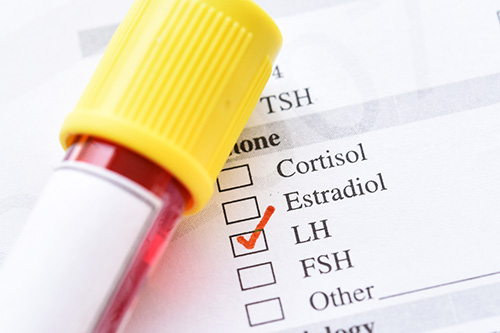
Doctors offer a standard blood or urine test to determine a woman’s FSH level (follicle-stimulating hormone). Over-the-counter menopause test kits check your urine (much like a pregnancy test) for an elevated FSH level on a particular day. Although advertisements compare the menopause test to a pregnancy test and indeed it looks like one, the results cannot be interpreted in the same way.

FSH is a hormone secreted by your pituitary gland in your brain in response to low estrogen levels — that’s how FSH and menopause are related. High FSH levels can indicate a perimenopausal or menopausal state during that particular cycle.

During a regular menstrual cycle, FSH levels begin to rise slowly a day or two before the onset of your period. FSH stimulates the ovary to ripen a follicle, and in concert with another hormone, LH (luteinizing hormone), to release an egg. After that, FSH levels fall off and progesterone levels rise as your uterus prepares for pregnancy or another period.

The menstrual cycle
© 2008 Women to Women *

For more information on hormones and your cycle, please see our articles on menstruation and irregular periods.

What menopause and FSH test kits don’t tell you

In one’s 40’s and 50’s, and even to some degree in one’s 30’s, the ovaries are more susceptible to external influences such as stress, diet, and toxins. You may not cycle in perfect textbook fashion. Or you may have regular cycles but not release an egg (called an anovulatory cycle).

If you took a blood or urine test during that kind of cycle, your estrogen and progesterone levels might be imbalanced and your FSH levels would test normal. You may be having night sweats and hot flashes but still having periods, and your FSH levels would be normal but your estrogen and progesterone levels out of balance. Or let’s say you’ve had a few skipped periods, in which case you would have high FSH as your body tried to stimulate ovulation. In both cases a menopause test kit would indicate that you were menopausal.

But then let’s say you start eating better, the sun comes out, you’re more relaxed, and you start on some good supplements. Your regular periods return and your FSH level dips back down to normal. A test of your FSH levels taken then would indicate that you were not in early menopause.

So how can you be both? You can because perimenopause is not a static thing. We move in and out of it depending on our hormonal balance. Women will find that they can be a little bit menopausal now and then, flowing in and out of it for ten or more years.

This is why we have not found the menopause tests to be very useful. The results are very changeable. They test for black or white and a woman’s hormonal balance is gray.

What Women to Women does to test for menopause

At our practice we follow the old adage, “Where there’s smoke, there’s fire.” We prefer to have our patients and members listen to their bodies, regardless of how old they are, and go from there. That’s why we offer a hormonal profile.

If you think you may be having symptoms of hormonal imbalance, take our health profile quiz. You might be experiencing some of the changes of perimenopause, and still have normal FSH levels.

And what if you are? What does this really mean? Again, it’s difficult not to buy into the negative stereotype of menopause. We see this transition as an opportunity to evaluate your present and change the things that make you feel unhealthy. At our practice, we’ve witnessed so many women make this transition and end up feeling healthier and happier then ever before.

And I think some of the attitudes toward menopause are following suit. Now there are groups of women friends getting together and singing along with songs from “Menopause the Musical.” Others are proudly wearing T-shirts saying “I’ve changed!” More books and articles are out now, telling us inspiring stories of midlife changes that women have made.

One thing is certain: we don’t want to be as invisible as our mothers were. Still, I’ve yet to see a greeting card congratulating a woman on reaching menopause — maybe we should offer that!

One woman’s experience with a menopause test

I was curious about over-the-counter menopause tests, so I found one offered on the internet. The advertising was quite clever. It had pink borders and flowers and promised a fast, easy result.

To my dismay I did see one ad that highlighted the fact that the test was delivered in a plain, unmarked package — like contraband. I ask, what is there to hide? While I can see that you might not want the postman to know your business, the same ad claimed the product could be used with discretion. Since most urine collection is done in the privacy of your bathroom, again I wondered, who are they thinking should be embarrassed?

It’s almost as if they’re promoting the test as a way to determine whether or not you’re getting older without letting anyone else in on it. But don’t you think that your family, friends and colleagues know that already — after all, they’re getting older too, every day!

That same ad goes on to say that taking this test will give you information so you can take further steps to keep yourself healthy. But my guess is that your body will tell you whether or not it’s healthy long before you get a “positive” test result. And if you’re not feeling well and checking if it’s menopause with a kit, no matter what the result is, wouldn’t you want to be doing something positive for yourself?

These tests are not expensive — anywhere from $15 to $20, or two for $30. There is even a discount for buying in bulk. Perhaps the companies recognize that you can’t get a real reading from just one day, or maybe you’re supposed to share them. Now that’s an idea! Throw a big question-mark party and have everyone take a test (even the men; they have FSH levels, too, for sperm production)! Just tell everyone to read the results with a grain of salt.

What if I still want to take an FSH or menopause test?

Blood FSH levels can be tested by any lab or doctor’s office and may be a bit more accurate than urine tests. They are more expensive but are usually covered by insurance. Infertility clinics measure FSH as one measure of ovarian function. Birth control pills and hormone replacement therapy can affect the test results.

One blood test we do encourage our patients to have is a TSH test, which measures the level of thyroid-stimulating hormone. Many women suffer from some level of hypothyroidism in perimenopause, and it is too rarely diagnosed by conventional practitioners. Many of the symptoms are the same but the treatment is different. (To learn more, read our articles on hypothyroidism.)

Most women these days like to be as informed as possible about their health. This is smart proactive self-care, and I would always encourage you to learn as much as you can about your body. If you’re curious and want to send away for one of these tests, go ahead. But view the result within the context of your whole experience and trust your intuition about what is going on — you might be surprised.

A woman’s biology is not necessarily her destiny

I remember one of my patients, a young 35-year-old who came to me for a mammogram because her mother-in-law had breast cancer. Her intuition guided her to take the test and she was right — she had breast cancer, too. She eventually had a mastectomy with reconstruction and chemotherapy.

Her periods were never regular and she was not on tamoxifen medication. About four years later I saw her for a check-up. She said she’d been putting on weight and suffering flu-like symptoms. She assumed that she was going through early menopause. To her utter surprise a pregnancy test showed she was four months pregnant. She now has a beautiful two-year-old daughter.

So instead of putting a label on yourself, or worrying about whether you’re in menopause or not, listen to what your body is telling you. It knows you best. If you do take an FSH test, keep in mind the larger context of clinical signs and symptoms of menopause. But better yet, save the money for some self-care — spend it on a nice massage or a new pair of shoes.

* Adapted from information at McGill University and the University of Wisconsin.

Comment on this article:


Last Modified Date: 06/02/2011
Principal Author: Dixie Mills, MD


Our Promise

Questions about the Personal Program?

Call 1-800-798-7902

We're here to listen and help.