


Reviewed by Dr. Mary James, ND
Estrogen gets a bad rap for so many things. Women hear that too much estrogen causes breast disease, and too little causes everything from hot flashes to hair loss in menopause. We also hear from many women with concerns about “estrogen dominance” — a state of high estrogen levels blamed for a wide range of distressing symptoms as well as fibroids, endometriosis, hypothyroidism and breast cancer, too.
In this article
- Why estrogen dominance is about progesterone and testosterone, too
- When ratios aren’t normal: Three experiences
- Resolving estrogen dominance — the Women’s Health Network approach
While excessive estrogen can lead to problems, it’s a little more complicated than simply “too much estrogen.” To manage all your symptoms, it’s important to understand how your individual estrogen levels are related to your other hormones — particularly progesterone and testosterone. For example:
Some signs & symptoms of high estrogen-to-progesterone ratio
- Unwanted hair growth
- Irritability
- Breast tenderness
- Water retention
- Weight gain
- Cyclical migraines
- Headaches
- Mood swings
- Skin outbreaks
- Digestive imbalance
- Fuzzy thinking
- Irregular periods / anovulatory cycles
- Breakthrough bleeding, spotting
Some conditions associated with relatively high (or “unopposed”) estrogen levels
- Uterine fibroids
- Menorrhagia (heavy bleeding)
- Endometriosis
- Menstrual migraines
- PMS
- Breast/gynecological cancers
- Lupus
- Are your estrogen levels holding steady in perimenopause, while your progesterone levels are plummeting?
- Have your estrogen and testosterone levels been well above normal reference ranges, while progesterone has always been low?
- Or, are you adding extra estrogen unknowingly through certain lifestyle choices?
Each of these common scenarios — and many others — can create imbalance between the ratio of estrogen to other hormones and lead to problematic symptoms.
The good news is that by better understanding what underlies estrogen imbalance, you can determine your best natural options for feeling better. Let’s take a closer look.
Why estrogen dominance is about progesterone and testosterone, too
A healthy woman’s body maintains appropriate ratios of estrogens, progesterone and testosterone throughout life. A complex set of feedback loops determines how much or little of each hormone is being made at any one time. This ongoing communication takes place between the brain, the ovaries and the adrenal glands, acting in concert with all your other bodily systems.
That’s why we use the phrase hormonal balance when we talk about “normal” ratios of hormones. But hormonal balance doesn’t mean a steady-state, equal balance — like the scales of justice or a perfectly balanced seesaw — but a dynamic equilibrium. Within this dynamic there are reference ranges. When your hormones fluctuate outside of these ranges, that’s when you are most likely to experience symptoms.
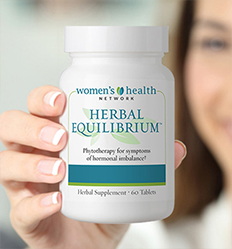
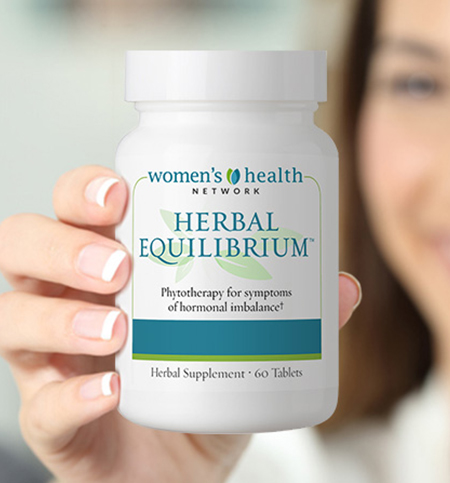
Herbal Equilibrium
Doctor-formulated for natural relief of symptoms related to hormonal imbalance
Fluctuations in estrogen can have dramatic effects on how we feel, think and function. Compared to other hormones, estrogen is very tightly regulated by the body, and it’s more powerful in smaller amounts than other steroid hormones. Even tiny changes in estrogen levels can cause symptoms.
When ratios aren’t normal: Three experiences
Keep in mind that your hormones are continually changing — even on a moment-to-moment basis. Diet and lifestyle have a tremendous effect upon your entire neuroendocrine (brain-hormone) system — and directly impact your estrogen and overall hormonal balance. So do your genes, which influence not just how your body produces hormones, but how it responds to them.
Let’s look at the experiences of three women, each of whom has “estrogen dominance” issues.
Scenario 1: Adding estrogen through lifestyle
Kylie, 23, is in her last year of college — squeezing in every party while still keeping her 4.0 average. Lately, she’s felt fatigued, anxious and tense just before her period, and her irritability quotient is off the chart. She’s had these problems since puberty, but they’ve gotten much worse in college.
What’s happening? Many women unknowingly alter their estrogen metabolism through lifestyle choices. Kylie’s social drinking is moderate, but she regularly burns the candle at both ends and relies on a caffeine fix the next day. And her college-student diet of fast food isn’t helping. All these factors could be slowing her liver’s capacity to metabolize estrogen, and Kylie could also be lacking key nutrients.
What could she do to help her symptoms?
A daily, top-notch multivitamin–mineral complex could help Kylie get more B-complex vitamins and omega-3 fatty acids — nutrients that favor proper energy regulation and estrogen metabolism. This in turn will help improve her sleep, decrease her cravings and reduce the fatigue, irritability and anxiety she experiences.
Scenario 2: Plummeting progesterone in perimenopause
Sue, 46, has had occasional menstrual migraines for years, but now she’s experiencing unpredictable and extremely heavy periods, too. An ultrasound revealed she has a large uterine fibroid. Her practitioner is recommending a hysterectomy, but Sue is looking for a less invasive alternative.
What’s happening? A sharp decline in progesterone right before your period can trigger a menstrual migraine. And if it occurs when your estrogen is also declining (which is common at Sue’s age), the drop-off can lead to erratic or excessive bleeding. Also, the relative abundance of estrogen in comparison to progesterone can support development of uterine fibroids. Our article “What is perimenopause?” can help you understand more about hormonal imbalance during this time.
What could she do to help her symptoms?
Women with plummeting progesterone in perimenopause have several natural options to consider. A good place to start is with an endocrine-balancing phytotherapeutic formulation, especially effective along with dietary and lifestyle changes. Sue may also want to consider acupuncture and/or a trial of prescription-strength bioidentical progesterone before opting for a surgical solution.
Scenario 3: Extra estrogen after menopause
Valerie, 55, is in early menopause. Despite constant dieting, she is struggling with steady weight gain. She’s always been a little heavy in her hips and thighs, but now it seems like the less she eats and the more she exercises, the more weight she gains.
What’s happening? Some women’s bodies are more prone than others to accumulate fat — especially around the waist, hips and thighs. This is a survival feature that can be beneficial for women in menopause because body fat produces estrogen and other hormones.
But in this day and age, extra fat in menopause can be problematic. Our fat cells produce excess estrogen, and we often have trouble metabolizing it, especially when our food is less than ideal. Endocrine disruptors in our environment known as xenoestrogens cause even more excess estrogen to accumulate in our fat cells, disrupting our hormonal metabolism and balance still more.
What could she do to help her symptoms?
Valerie shares a problem with many women today, who would benefit greatly from piling on the vegetables. It sounds simplistic, but plant foods contain two things — phytochemicals and fiber — that enhance estrogen metabolism in the body and support healthy weight. Adding phytotherapy, including soy isoflavones and herbs such as red clover and kudzu, can further benefit her estrogen metabolism, help her detoxify any toxins in her system and promote healthy estrogen metabolism.
Resolving estrogen dominance — the Women’s Health Network approach
No matter what your age or individual levels of hormones, there are ways to give your body the natural support it needs to build better hormonal health. For most women, a combination approach works beautifully.
Phytotherapy — a gentle approach to a complex issue. If you are like many women, you can probably benefit from an approach that incorporates phytotherapy. We’ve found the following medicinal herbs to be beneficial for women with symptoms of estrogen dominance:
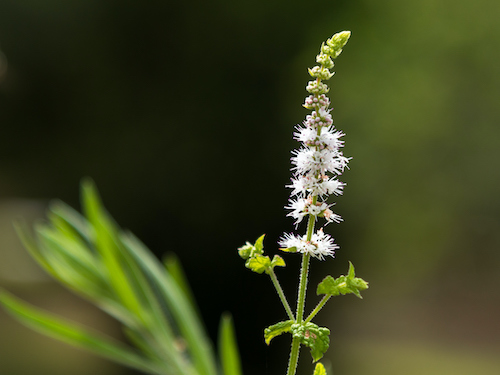
- Black cohosh
- Ashwagandha
- Chasteberry
The use of a well-balanced botanical formulation such as our Herbal Equilibrium is most effective when combined with nutritional and lifestyle modifications.
Herbal Equilibrium
Doctor-formulated for natural relief of symptoms related to hormonal imbalance
Dietary and lifestyle changes. Lifestyle is a critical factor in the production and storage of estrogen, progesterone and testosterone to support hormonal balance. Here are four simple elements to start with today.
- Limit exposure to xenoestrogens. Choose organic foods when possible, and wash your produce. If you include animal foods in your diet, select those that were sustainably raised without hormones and harmful chemicals. Avoid plastics for heating or storing food, and limit body care and cleaning products to those with all-natural ingredients.
- Eat a natural, plant-based diet. Eating lots of vegetables provides fiber, which feeds the beneficial flora in your intestines, which help you metabolize your hormones the way Mother Nature intended. Plant foods also provide your body with phytoestrogens, which protect your body from damaging xenoestrogens. Good choices include legumes, licorice, yams and anything in the broccoli/cabbage family. Foods to avoid include those made with refined flours, sugars, partially hydrogenated fats and artificial ingredients.
- Restore balance with supplements. We generally recommend high-quality daily nutritional supplements to help restore a woman’s hormonal balance. Because they work as molecular messengers, nutrients such as B-vitamins and omega-3 fatty acids can help increase your body’s ability to balance its hormone ratios.
- Manage stress levels. Most women have skipped a period or two while under stress — one obvious effect of stress on our hormonal cycles. In relation to estrogen dominance, one theory is that stress fuels chronically high levels of adrenaline and cortisol, stress hormones known to alter the feedback loops regulating our sex hormones.
Even with this type of support, there are still many women whose bodies produce an abundance of estrogen. These women may continue to experience symptoms and conditions associated with estrogen dominance. Such women may find dramatic improvement by adding bioidentical progesterone. If this describes you, then it’s probably worthwhile to talk to your practitioner.
Find your unique path to hormonal balance
The concept of estrogen dominance came to the forefront of women’s health through the work of Dr. John Lee, who pioneered the idea that low levels of estrogen are not the only cause of menopausal symptoms. While we understand now that the equation isn’t as simple as “Too much estrogen — just add progesterone,” Dr. Lee captured the public’s attention and moved us all forward in how we view the complexities of hormonal balance. As we continue learning more, we intend to keep looking for gentle interventions that restore balance best — and most naturally.
1 Diaz–Cruz, E., et al. 2011. Comparison of increased aromatase versus ER{alpha} in the generation of mammary hyperplasia and cancer. Cancer Res., 71 (16), 5477–5487. URL (abstract): https://www.ncbi.nlm.nih.gov/pubmed/21840986 (accessed 08.17.2011).
[No author listed.] 2011. Increased estrogen production could increase risk of breast cancer. Ivanhoe Newswire. URL: https://www.ivanhoe.com/channels/p_channelstory.cfm?storyid=27830 (accessed 08.17.2011).
2 Hays, B. 2005. Chapter 19. Hormonal imbalances: Female hormones: The dance of the hormones. Pt. I. In Textbook of Functional Medicine, 216. Gig Harbor, WA: Institute for Functional Medicine.
3 Zhang, C-X., et al. 2011. Effect of dietary fiber intake on breast cancer risk according to estrogen and progesterone receptor status. Eur. J. Clin. Nutr., 65 (8), 929–936. URL (abstract): https://www.nature.com/ejcn/journal/v65/n8/abs/ejcn201157a.html?WT.ec_id=EJCN-201108 (accessed 08.04.2011).