



Reviewed by Dr. Mary James, ND
While thyroid problems are extremely common, many women experiencing symptoms may still not get the help they need from their doctors. That’s why it’s so important for women to understand how their thyroid works — and what can be done to support it.
Symptoms of low thyroid function
- Fatigue
- Poor concentration
- Constipation
- Unusual weight gain or change to body shape
- Skin issues
- Dry, coarse, or thinning hair or hair loss
- Depression
- Sensitivity to cold
What does the thyroid do? Your thyroid gland produces hormones that regulate energy levels, healthy weight, and the metabolism of each and every cell in your body.
And when the thyroid isn’t working properly, especially when it’s sluggish, your body can feel significantly imbalanced and overcome by troubling symptoms.
What does the thyroid gland do?
As part of the endocrine system, the thyroid maintains your body’s overall balance. It’s one of the most important glands in your body and affects many systems and functions:
- Metabolism
- Brain development
- Breathing, heart and nervous system function
- Blood cell production
- Muscle and bone strength
- Body temperature
- Menstrual cycles
- Weight gain and loss
- Cholesterol levels
- Skin hydration
How the thyroid works
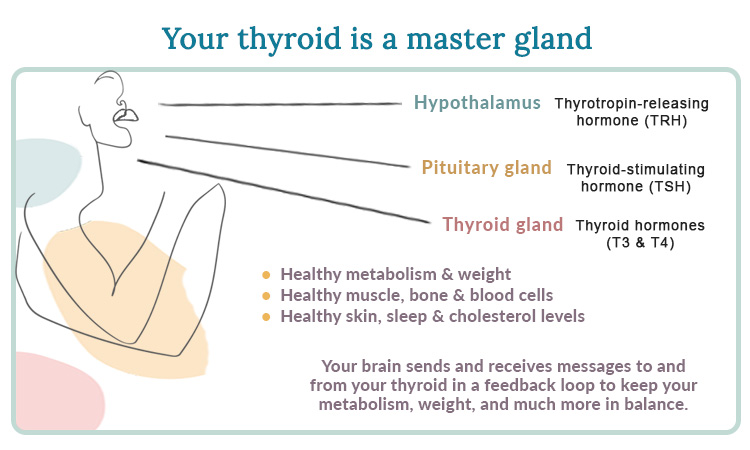
The thyroid does its job by sending and receiving messages to and from your brain to produce and release two thyroid hormones.
Two thyroid hormones
1. T3 (Triiodothyronine): T3 is the thyroid hormone that our cells use most effectively. It is the only biologically active thyroid hormone in the body.
2. T4 (Thyroxine): T4 serves as the building block for the production of T3. T4 is converted into T3 in the liver and kidneys.
The thyroid and the brain work together and communicate in a constant – and sensitive – feedback loop.
If more T3 or T4 is needed, your brain sends chemical messages to get this started. Thyrotropin-releasing hormone (TRH) is released from the hypothalamus. This triggers your brain’s pituitary gland to send thyroid-stimulating hormone (TSH) to your thyroid, which releases both T3 and T4.
If less of these hormones is needed in the body, these messages from your brain to your thyroid are quieted until your thyroid hormones are in balance again. At least that’s the way it’s supposed to work.
What are hypothyroidism, subclinical hypothyroidism and hyperthyroidism?
Unfortunately, the feedback loops between the thyroid and the brain are easily disrupted if you aren’t getting enough of specific nutrients like iodine, selenium, tyrosine and B vitamins. Also, too many carbs and too little protein can both interfere with the conversion of T4 into T3. And stress also affects your thyroid. If communication is disturbed in any way, not enough T3 or T4 is produced, released or converted, and your body notices.
Without the right amount of these hormones available for your cells, your body can experience symptoms or problems like hypothyroidism, subclinical hypothyroidism or hyperthyroidism.
Hypothyroidism
Hypothyroidism occurs when your thyroid hormones are too low to fully support even your basic daily activities. This can be due to either inadequate production of T4 in your thyroid gland, or poor conversion of T4 to the more active T3 hormone.
Hypothyroidism can cause severe fatigue and loss of energy, dry skin, hair changes, general puffiness, constipation, cold intolerance and more. It can also increase cholesterol levels and aggravate issues like PMS, menstrual irregularities and fibrocystic breasts.
Low thyroid, or hypothyroidism, is one of the most common forms of hormonal imbalance.
Subclinical hypothyroidism
Subclinical hypothyroidism is suspected when there are symptoms of hypothyroidism even though standard thyroid test results are still in the “normal range.”
Subclinical hypothyroidism can cause all of the same symptoms of hypothyroidism.
Women in this category often feel much better when their thyroid function gets support.
Hyperthyroidism
Hyperthyroidism is caused by the thyroid producing too much thyroid hormone.
Hyperthyroidism can cause nervousness and anxiety, increased heart rate or palpitations, breathlessness, diarrhea, insomnia and depression.
How do you know if you have subclinical hypothyroidism?
The TSH and T4 tests are two common measures used to see how your thyroid is functioning. Many times women who suspect a thyroid issue are told by their doctors that these tests came back “normal.” But that doesn’t mean the thyroid is functioning optimally. Unfortunately, “normal lab ranges” for thyroid function used by conventional medicine may not be specific enough to identify subclinical problems. This leaves countless women to manage their symptoms alone.
Do you think you have low thyroid?
If you’re suffering from the symptoms of low thyroid – fatigue, unusual weight changes and more…
Take our simple thyroid quiz to find out if you might have low thyroid.
Ideally, thyroid levels should stay in the middle of these ranges:
| TSH: | 0.4–4.0 mIU/L (if you have no hypothyroid or hyperthyroid symptoms) 0.3–3.0 mIU/L (if you’re being treated with thyroid hormone) |
| T4: | 4.8–13.2 mcg/dL |
| Free T4: | 0.9–2 ng/dL |
| T3: | 80–200 ng/dL |
For example, most conventional medicine labs typically set the “normal” range for TSH between 0.4 to 4.0 mIU/L, but functional medicine practitioners like to see TSH stay as close to 2.0 mIU/L as possible. A higher level can indicate low thyroid function in many women.
Also, trends in your thyroid function – if levels are creeping up or down over time – are always important to know about.
How does the thyroid interact with sex hormones and adrenal function?
The thyroid, adrenal and sex hormones are all connected through the brain’s hypothalamus and pituitary glands. These areas help control the increase and decrease of the various hormones released by the adrenals, thyroid, ovaries, and other endocrine tissues.
Since the thyroid and ovaries are part of this feedback loop, periods of naturally-shifting hormones can cause extra disturbances in the thyroid. As a result, be especially aware of any thyroid symptoms that appear during these times:
Pregnancy. During a healthy pregnancy, estrogen and the pregnancy hormone hCG (human chorionic gonadotropin) increase thyroid hormone levels in your blood. Because of the natural shifting of hormones during this time, hypothyroidism and/or hyperthyroidism can occur during or after pregnancy.
Perimenopause. During perimenopause, estrogen, progesterone and testosterone are in flux. These fluctuations can affect messages sent to the brain regarding thyroid hormones. As we produce less estrogen, TRH can also slow down, resulting in less available T3 and T4 for our cells.
Times of stress. The thyroid gland can be affected when you’re under stress because of its connection to the adrenal glands (your stress responders). During chronic stress, the adrenal glands pump out the stress hormones, cortisol and adrenalin. Although these hormones help our bodies adapt to stress, too much of them can also inhibit TSH and the conversion of T4 into T3. The result is low thyroid function.
Do you think you‘re experiencing low thyroid function?
If you’re suffering from low thyroid – fatigue, unusual weight changes and more, it helps to know more. Then you can find a simple solution to resolve your specific hypothyroid symptoms.
Norman Endocrine Surgery Clinic. 2005. How your thyroid works. URL: https://www.endocrineweb.com/thyfunction.html.
Lombard, J. 2005. Chapter 32. Clinical approaches to hormonal and neuroendocrine imbalances. Section VI: Neurotransmitters: A functional medicine approach to neuropsychiatry. In Textbook of Functional Medicine, ed. D. Jones & S. Quinn, 644. Gig Harbor, WA: Institute for Functional Medicine.
National Endocrine and Metabolic Diseases Information Service. 2008. Pregnancy and thyroid disease. URL: https://endocrine.niddk.nih.gov/pubs/pregnancy/.