
Bone health
Acid-alkaline balance — is your diet the key to healthy bones?
by Dr. Susan E. Brown, PhD
Topics covered in this article:
There’s a very simple approach to improving the health of your bones that
practitioners here in the US have overlooked for almost a century now. It’s
available to anyone, it’s natural, and it’s not even terribly expensive
— you don’t even need health insurance to use it. That’s because
the approach is based on understanding our internal chemistry, specifically our
pH balance, and learning how to make nutritional and lifestyle choices to keep our
pH in the optimal range.
So what does pH have to do with bone health? In the human body, there is a fairly
narrow, slightly alkaline pH that’s required for health. Although some of
our bodily fluids are acidic (urine has a pH of about 6, and stomach acid is about
1), overall our tissues maintain a slightly alkaline pH of just above 7. Since there
are many factors that can make us more acidic — we’ll talk about them
in a moment — the body is constantly monitoring and adjusting its acidity
and alkalinity. And our bones are at the very center of this acid-alkaline dance!
Our bones are the guardians of our pH balance, so if our pH is outside the proper
range, our bones give up minerals to restore pH at the expense of using those minerals
to repair bone and build bone density — literally sacrificing themselves.
pH basics*
The term pH literally means potential for hydrogen. It’s used to
designate the concentration of hydrogen ions in a given fluid. The more hydrogen
ions, the more acidic the fluid is. Here are the fundamentals:
- pH is measured on a logarithmic scale of 0 to 14.
- 7 is neutral — neither acidic nor alkaline.
- Anything above 7 is considered alkaline or “basic.”
- Anything below 7 is considered “acidic.”
- Blood pH must be tightly regulated between 7.35 and 7.45.
- pH of other bodily fluids varies more widely (urine pH, for example, can range between
4.5-8.0).**
* The Acid Alkaline Food Guide, p 11.
** Minich and Bland, 2007
Unfortunately, our modern lifestyle — most notably the standard American diet
(which I like to call “SAD”!) — encourages chronic low-grade metabolic
acidosis, a condition in which our body’s pH is regularly, even continually,
tilted toward the acidic end of the ideal range. But by making some simple changes
in your diet and lifestyle, you can quickly and successfully shift the body away
from a low-grade acidic state back to an ideal balance. These simple choices will
not only support the functioning of your organs overall, they can strengthen your
bone health dramatically.
Now, I realize this may sound pretty “nut and crunchy” to a lot of you.
But I want to share with you that in over 20 years of working with women at the
Center for Better Bones, I’ve witnessed tremendous improvement in the bones
of women who move toward an alkalizing diet. So let’s take a closer look at
how your bones maintain acid-base balance in your body, and how supporting your
body’s pH can make the difference to your bone health as well as healthy aging
and longevity.
What pH means to your health
The body is alkaline by design, but acid by function.
— Albert Szent–Gyögyi
Nobel Laureate and discoverer of vitamin C
We evolved in an alkaline or “basic” mineral-rich ocean environment.
Even today, as a lick of your blood, sweat, or tears will attest, our body’s
internal environment remains salty and alkaline. It’s perfectly logical that
our enzymatic, immunologic, and repair processes all function at their best in an
alkaline environment.
At the same time, our everyday bodily functions produce a tremendous amount of acid.
The molecular fuel we use to contract our muscles during intense exercise, for example,
produces a build-up of positively-charged hydrogen atoms (protons), which makes
us more acidic. In digesting sulfur-containing foods like animal proteins, we produce
sulfuric acid as a metabolic by-product, and every time we breathe our lungs produce
volatile carbonic acid, which is then exhaled. Even our detox, immune, and stress
responses create substantial acidic by-products. So the body has the minute-to-minute
task of neutralizing or excreting all this acid, bringing itself back to the alkaline
environment that’s best for our cells. In fact, your life depends on getting
it back into balance!
Many people find it hard to believe that small fluctuations in pH can have dramatic
effects on our health. For blood pH, it helps to think of body temperature: we function
best when our bodies maintain a temperature of about 98.6 degrees Fahrenheit. When
that number goes up or down — even just one or two degrees — we feel
unwell, and our body uses a host of mechanisms like shivering and sweating to reset
the thermostat. With our blood pH, the range is held tightly between 7.35 and 7.45
in our arteries, and between 7.31 and 7.41 in our veins. If a shift of even 0.1
above this range occurs in the blood pH, the blood becomes unable to deliver adequate
oxygen and protect us from disease.
What’s an alkalizing mineral?
A note on biochemistry
When we speak of alkalizing minerals, understand that it is not really
minerals themselves that alkalize, but the negatively charged anions attached to
the minerals — like the citrate in potassium citrate, or the carbonate in
calcium carbonate, or the ascorbate in calcium ascorbate. So I like to speak of
mineral complexes, or alkalizing mineral salts.
Most of these complexes are found in highest amounts in vegetables and some fruits,
which are universally the best place to get them — even when it comes to calcium,
the complexes found in leafy green vegetables such as bok choy are absorbed more
readily than those in dairy foods. So when you hear those
Got Milk? ads talking about the calcium you need for strong bones,
understand that it’s not really the calcium that matters most — and
you’d do better to “get bok choy” in any case!
Likewise, we have several built-in mechanisms to regulate pH, involving our kidneys,
lungs, and skin. The lungs help by excreting acids as carbonic acid, which is basically
carbon dioxide dissolved in water, and they do this without much effort or input
from us. The kidneys excrete acids through the urine after neutralizing them by
drawing on available sodium and potassium salts from the blood and tissues (such
as the muscle tissues). But if the kidneys face excessive acid levels or insufficient
minerals in the blood and tissues, the body is obliged to tap into our bones’ alkaline mineral
reserves, or the delicate kidney tissue will be burned by the acids.
How your bones help maintain pH balance
The vast majority of the alkalizing mineral complexes in our bodies are stored in
our bones, where they serve several purposes. They give our bones strength while
maintaining a reserve for pH regulation of the blood and other bodily fluids should
the need arise. Alkalizing or “basic” minerals serve to balance the
effects of slight blood acidity. With even small variations in acidity, the body
draws alkalizing minerals first from the blood, then from tissues such as muscle,
and ultimately from the bone stores.
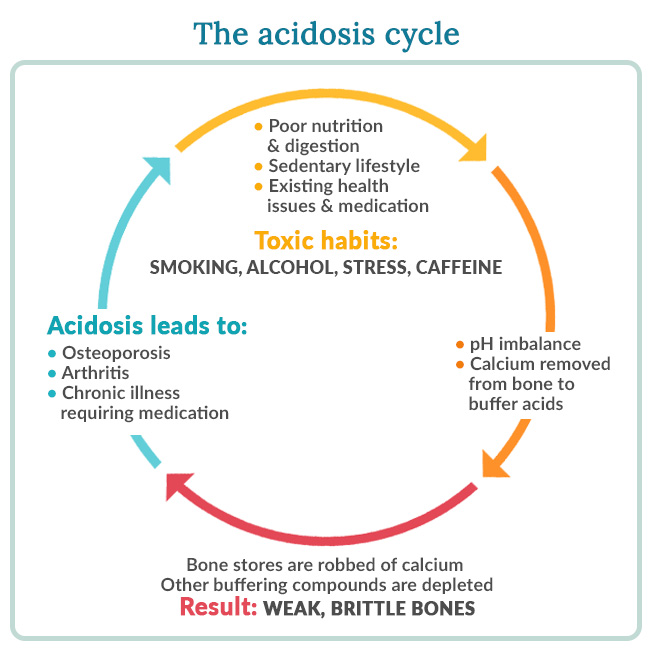
Thus, when our diets lack the mineral salts needed to alkalize acid-forming foods,
our bone reserves will be tapped quite frequently. Over time, an imbalanced diet
of refined foods with excess animal protein, few fruits and vegetables, and poor-quality
salts can allow our bodies to slip into a state of mild acidosis. Chronic stress,
excessive or insufficient exercise, and environmental toxins also contribute to
this acid burden. Over the long term, this continual acidosis requires more and
more of our mineral reserves to be drawn from the bones and used to restore our
pH.
And it doesn’t take much to start this process. Osteoclasts (bone
breakdown cells) are very sensitive to small changes in pH. In fact, it has been
shown that a mere one-tenth of a drop in blood pH greatly stimulates our osteoclasts,
inhibits osteoblasts (bone-building cells), and induces a bone mineral
loss.
Sources of chronic, low-grade metabolic acidosis*
- Diet
- Distress (excess cortisol and adrenaline)
- Delayed immune system reactions (from delayed immune sensitivities or reactions).
- Environmental toxins
While this slightly acidic state isn’t associated with obvious immediate symptoms,
it can slowly lead to osteoporosis and other degenerative health disorders. For
example, loss of sodium and potassium reserves can leave many women susceptible
to blood pressure and other cardiovascular problems. Metabolic acidosis can also
affect protein metabolism, which can result in muscle wasting and decreased cell,
tissue, and organ repair. Accumulated acids lead to accelerated aging, increased
free radicals, and impaired antioxidant activity. Acidosis may also increase your
risk of kidney stones, fluid retention, imbalanced gut flora, and growth of yeast,
fungi, and bacteria, which all thrive in an acidic environment.
Causes of chronic low-grade metabolic acidosis
Whether we know it or not, most of us are affected by a low-grade metabolic acidosis
simply because we live in the modern world. Never before have our topsoils been
so stripped, and our food supply chain as a whole been so devoid of minerals and
other vital nutrients. And never before have we eaten a diet so high in animal proteins,
sweeteners, and processed food with so few fruits and vegetables, been under so
much chronic stress, or exposed ourselves to such a vast array of pollutants.
In terms of diet, most of our so-called modern conveniences are not helpful to our
bodies’ pH balance. High-protein power bars, ultra-caffeinated drinks, highly
processed “fast” and “convenience” foods full of fillers
and fats, refined flours and sugars are all acid-forming foods and our bones are
paying the price! Yet when we move toward a diet full of alkalizing foods like
whole fruits, vegetables, nuts, seeds, and spices, we can quickly ease a great deal
of this burden, using food to our bones’ advantage instead of their disadvantage.
Let’s look at how this really works in our bodies with a can of cola. A simple
12-ounce can of cola has a pH somewhere between 2.8 and 3.2, but our kidneys can’t
excrete urine with a pH much lower than 5 without damaging the urinary tract. To
process 12 ounces of cola to the point at which it can be excreted in the urine
at a pH of 5, it must be diluted a hundred-fold, requiring that either the body
must produce an additional 33 liters of urine (not likely to happen, since drinking
enough water to make that much would be equivalent to drowning!), or a corresponding
amount of buffer must be drawn from the body to neutralize the excess acid. This
is a lot to buffer, and it’s just one little can of cola! Now imagine the
effects of a can a day (or more!) for 10 to 20 years.
Some alkalizing fruits and veggies*
For more foods, see our chart on the acid-alkaline food spectrum and my book, The
Acid-Alkaline Food Guide.
Vegetables
- Sweet potatoes/yams
- Onion
- Garlic
- Asparagus
- Kale
- Arugula
- Endive
- Broccoli
Fruits
- Limes
- Nectarines
- Raspberries
- Watermelon
- Tangerine
- Pineapple
- Grapefruit
- Cantaloupe
- Raisins
* Brown, S., Jaffe, R. 2000. Acid-alkaline balance and its effect on bone health.
International Journal of Integrative Medicine, 2 (6), 7–18.
Keep in mind that food isn’t the only culprit here. Many women are exposed
to overwhelming amounts of stress that can also add to the acid burden and affect
our bones. When we’re feeling overwhelmed by work, getting little sleep, eating
poorly, or even when our minds are whirling over some problem — the list can
go on and on — our bodies release stress hormones known as adrenaline and
cortisol. If this sort of stress impacts your life now and again, you can usually
recover, but if this is your life all the time, it becomes damaging in the long
run. Sustained at high levels, stress hormones can certainly tilt the body toward
acidosis and otherwise deteriorate bone health.
But I have some good news for you — you can relieve a great deal of the acid
burden in your bones by making some simple food choices. When you do, your bones
will be able to use their mineral stores for building bone, rather than fighting
acidosis.
Alkalize your diet — the Better Bones approach
Though there are lots of other natural ways to strengthen bones and stimulate new
bone growth, the alkaline diet is a simple, quick, and effective first step —
and it will shore up your health on many other levels, too.
Classic studies tell us that the body can neutralize about 50 mEq (milliequivalents)
of fixed metabolic acids per day from a “typical” intake of fruits and
vegetables, without going into alkaline reserves. But unfortunately, the diet that
most people in the US eat produces as much as 100 mEq per day — almost twice
what the body can handle. This is because very few people in the United States population
meet the fruit and vegetable serving recommendations (two to four servings of fruit
and three to five servings of veggies, depending on age, gender, and activity levels).
And these recommendations are the minimum — most people would be better off
exceeding them and consuming 9–13 servings of vegetables and fruits a day.
Here are ten simple dietary tips for shifting your body back into its alkaline comfort
zone. You can also see the Acid-Alkaline Food Guide to see where
some common foods fall on the acid-alkaline spectrum.
1. Eat more veggies and fruits. This is the most important
step of all — even if you can get no further down the list than this, you
can instantly make a huge difference to your bones. Plant foods contain abundant
organic anions (negatively-charged “basic” particles) that combine with
cations (positively-charged, or “acidic” particles) when metabolized,
in turn reducing our net urinary acid load and naturally creating alkaline balance
in the body. Again, keep in mind that the mineral deficits in our topsoil and water
reduce the availability of minerals in the conventional food supply. If you want
better bones, we suggest more than the standard “five-a-day” servings
of vegetables, fruits, nuts, and seeds — nine to ten is better. As an aside,
our perspective on plant foods follows the adage that “fruits are cleansing,
vegetables are building” — fruits definitely have a place in the diet,
but if you want to build bone, we suggest you focus on the veggies!
2. Reduce soda intake, or eliminate it altogether. Clearly
my example above should demonstrate why soda pop isn’t good for your bones.
Aside from the overwhelming amounts of sugar, high-fructose corn syrup, aspartame,
or other chemicals of little to no nutritive value that soda contains, its high
phosphoric acid content requires your body to sacrifice a great deal of alkaline
buffering salts so it can excrete the acid without damaging your urinary tract.
3. Replace refined carbs with tasty roasted roots, tubers, and gourds.
Most grains are somewhat acid-forming — particularly when they are ground,
bleached, and otherwise refined. Root, tuber, and gourd crops like sweet potatoes,
yams, potatoes, parsnips, beets, carrots, squash and potatoes are super-rich in
minerals that will alkalinize your blood, plus they’re loaded with antioxidants
and vitamins. So instead of eating pasta, pizza, pastry, rice or bread, try substituting
with root crops a few days a week. While they are higher on the glycemic index than
many other vegetables, they are satisfying and again, micronutrient-rich.
4. Add fresh lemon and lime to your water. Though we typically
think of citrus fruits as acidic, they’re highly alkalizing in the body (limes
especially). This is due to the conversion of citric acid to citrates on digestion.
Help balance your acid load by squeezing a wedge of fresh lemon or lime into your
water bottle or glass throughout the day. For that matter, get into the habit of
giving your cuisine a squirt just before serving: lime is delicious on papaya, melons,
salads, Mexican and Asian dishes, and lemon juice can really make a soup, curry
or fish dish sing!
5. Consider adding sea vegetables to your culinary repertoire.
For some of you, I know this is “out of the question!” Others of you
will have already adopted this practice at one point or another in your lives, or
it may be part of your heritage. For others who are willing to try new things, why
not experiment with packaged sea veggies available in the macrobiotics section of
your health food store or Asian supermarket? Or, if you’re lucky enough to
live near a pristine beach, forage around and harvest a sample or two of your own.
Consider the fact that just a hundred years ago, much of the seaboard here in Eastern
North America was actively engaged in the harvesting of sea vegetables. While delicious
seaweed dishes are still regularly enjoyed throughout much of Asia, it wasn’t
so long ago that many people on both sides of the Atlantic were also enjoying dulse,
agar agar, and other mineral-rich seaweeds in soups, stews, and puddings (blanc
mange).
6. Drink 64 ounces of high-mineral spring water daily.
So often our public drinking supply has been processed, stripped of the health-enhancing
minerals water naturally picks up from the earth as it percolates through the ground.
Then it’s doctored with minerals like chlorine and fluoride which —
despite conventional wisdom — are present at levels that many scientists feel
are not healthy for teeth and bones. “Mineral waters” contain dissolved
minerals and trace elements in widely varying amounts as they emerge from their
sources in the ground. These include calcium, magnesium, and potassium salts, so
it’s an easy way to replenish your alkaline reserves. Since our diets are
for the most part high in sodium, I’d avoid the ones that contain sodium unless
you’re living in a hot climate or working out and sweating a great deal. We
like brands such as Essentia and San Pellegrino, but many people develop an allegiance
to this or that label, so I’d encourage you to sample a few and find your
own favorites.
7. Reduce animal protein to 60 g or less per day. Animal
proteins, which are high in the sulfur-containing amino acids cystine, cysteine,
and methionine, are particularly acid-producing as your body metabolizes them. Protein
is absolutely required for your bones and just about every other body tissue, but
you can limit your animal protein sources (beef, chicken, pork, eggs, and dairy
products) to 60 grams or less per day and upping plant-based protein sources. As
recently as one or two generations ago people ate beans nearly every single day,
sometimes at every meal, and in many places in the world legumes remain the number-one
source of protein. Lentils in particular have a super alkalizing effect on the body
compared to other protein sources, they cook more quickly than most other dried
beans, they’re versatile, and they’re also more digestible for many
people. Soy is another high-protein option you can try that’s high in calcium
and good for the bones.
8. Add cinnamon, ginger, and other herbs and spices. Cinnamon
is a wonderful alkalizing spice that you can add to just about anything. It’s
great with sweet potatoes, apples, or sprinkled in hot tea. Ginger root is a great
alkalizer and detoxifier that spices up many dishes and makes a tasty, warming winter
tea. Experiment with your spice cabinet — herbs and spices don’t just
make things taste better, in most cases they’re good for your health.
9. Monitor your urinary pH. Tracking your first morning
urine pH (after at least 6 hours of sleep) is a simple and convenient way to keep
track of how your nutritional changes are affecting your body. When this number
is between 6.5 (slightly acidic) and 7.5 (slightly alkaline), it indicates that
your overall cellular pH is likely where it should be — slightly alkaline.
Results in an acid range can suggest that your bones are being depleted of minerals
to offset the excess acid in your system. Super-sensitive and highly accurate, our
own pH Test Kit is designed to test either saliva or urine. See our
pH Test Kit for my recommendations
on tracking your pH.
10. Supplement your diet with a high-quality multivitamin–mineral complex.
No matter how attentive we are to what we eat, where it’s grown or harvested,
and how we dish it up, we just can’t always have a perfectly balanced diet.
You still have lots of options when it comes to making up for that fact of life,
one of which is the peace of mind a top-notch bone-healthy supplement provides,
like the ones we offer in our Personal Program for Better Bones. These formulations
are designed to enhance pH balance through an alkalizing nutrient base, plus they
provide a potent dosage of the key nutrients required for deep bone nourishment.
Should your pH stay low after several weeks of this, you may have a greater need
for alkalizing mineral complexes — so feel free to contact us for help.
Food is nature’s best medicine
The direct relationship between pH balance and your bones reminds us of the
fact that our bodies were meant to eat mineral-rich foods straight from the earth
and sea. As we’ve moved away from a whole foods diet, we’ve seen increases
in not just osteoporosis, but cancer, heart disease, and diabetes. Though many still
believe that the food equation can be simply broken down to calories-in and calories-out,
the micronutrients in our food speak actively with every cell in the body —
including the osteoblasts and osteoclasts that make and break our bones daily.
The Greek physician Hippocrates said that food should be our first and most important
medicine. This is truer now in the 21st century than ever before. With a pill to
pop for every ailment and all of the corresponding side effects, it’s time
for a new approach. If you are concerned with the strength of your bones, start
here with an alkaline diet. We’ve used it to help women in all stages of bone health.
Our Personal Program for Better Bones is a great place to start
The Personal Program for Better Bones promotes natural bone strength and regeneration
with nutritional supplements, our exclusive bone builder formula, dietary and lifestyle
guidance, and optional phone consultations with our Nurse-Educators. It is based
on over 25 years of research and experience and has helped thousands of women reclaim
their bone health.
- To learn more about the Personal Program for Better Bones, go to
How it works.
- To choose the version of the Program that’s right for you, go to
Compare plans.
- To assess your bone health and fracture risk, take our free
Bone Health Profile.
- To start taking control of your bone health today, sign-up for a
risk-free trial.
If you have questions, don’t hesitate to call us toll-free at 1-800-685-3275.
We’re here to listen and to help.
Related to this article:
References & further reading on
acid-alkaline balance
Original Publication Date:01/01/2009
Last Modified:
11/20/2009
Principal Author: Dr. Susan E. Brown, PhD