


By Dr. Susan E. Brown, PhD When it comes to improving your bone health, very little you do matters more than improving your acid-alkaline balance with alkaline-forming foods. Even if you exercise, if your diet is heavily tilted toward acid-forming foods, you may still have unnecessary bone loss in the long run.

An alkaline diet plan is an essential part of natural bone health, as we’ll explain today. Table Of Contents:
- What is the alkaline diet?
- What pH means to your health
- How bones help maintain pH balance
- Is your diet acid-forming or alkaline-forming?
- What are problems with an acid-forming diet?
- How to start an alkaline diet?
- Alkaline diet plan: Sample day
What is the alkaline diet?
“Eating alkaline” simply means selecting foods that provide minerals and nutrients that neutralize acids produced in the body (something we’ll discuss more below). For the most part, such nutrients are found in plant foods — leafy greens, fruits, root crops and many others. An alkaline diet also means limiting your intake of foods that tend to make body tissues more acidic — which includes meat, grains, dairy and sugary or processed foods. This doesn’t have to mean eliminating such foods — you can still include them in your diet in moderation. In some cases, these foods might provide vital nutrients, like the B12 vitamins in meat, so complete elimination might prove counterproductive! To truly eat alkaline, you need to make such acid-forming foods a fairly small part of your diet. A good rule of thumb is that if your diet is 80% whole, fresh fruits, vegetables, leafy greens and root crops, and 20% meat, grain, dairy and so forth, then you’ve got an alkaline diet. But why go to all this trouble? What’s the benefit of eating alkaline? To understand that, you need to know a little about the body’s acid–base balance.
What pH means to your health
There’s a simple reason why eating alkaline is good for health: our everyday metabolic processes produce a tremendous amount of acid. When we digest foods with sulfur-containing amino acids, like animal proteins, we produce sulfuric acid as a metabolic by-product. When we exercise, our muscles produce lactic acid. Even our detox, immune and stress responses can create substantial acidic by-products. Many people find it hard to believe that small fluctuations in pH can have dramatic effects on our health, but as research clearly shows, they can! With our blood pH, the range is held tightly between 7.35 and 7.45 in our arteries, and between 7.31 and 7.41 in our veins. If a shift of even 0.1 above this range occurs in the blood pH, the blood becomes unable to deliver adequate oxygen and protect us from disease. This means that the body has the minute-to-minute task of neutralizing or getting rid of all this acid and bringing it back to the alkaline environment that’s best for its cells. The body works extremely hard to make sure the pH in the blood is stable and our continued life depends on this. Because of this, our blood pH will always be in range unless there is some very serious illness which needs medical attention.
How bones help maintain pH balance
We have several built-in mechanisms that regulate pH, involving our kidneys, lungs and skin. But if the kidneys face excessive acid levels or insufficient buffering minerals in the blood and tissues, then the body is forced to tap into our bones’ alkaline mineral reserves, or the delicate kidney tissue will be burned by the acids. The vast majority of the alkalizing mineral complexes in our bodies are stored in our bones, where they serve two main purposes:
- They give our bones strength.
- They maintain a reserve for pH regulation of the blood and other bodily fluids.
Alkalizing or “basic” mineral complexes balance the effects of slight blood acidity. With even small variations in acidity, the body draws alkalizing minerals first from the blood, then, if necessary, from tissues such as muscle, and ultimately from the bone stores. So the benefit of an alkaline diet is this: When your body needs to neutralize the acids formed in normal, daily life — and even more so when it needs to address some acid-forming stressor, like an illness or injury — by eating alkaline, you give it those minerals up front instead of making it turn to bones for what it needs.

Is your diet acid-forming or alkaline-forming?
There’s some confusion about what constitutes an “acid-forming” food, so let’s tackle one thing up front: A food that’s acidic in your mouth (like vinegar or citrus fruits) isn’t necessarily going to form acids in your blood stream. In fact, “acidic” foods like lemons are highly alkalizing because they produce a great many alkalizing minerals and nutrients once they’re digested. In general, most plant foods are alkalizing (with a few exceptions). Acid-forming foods include most high-protein foods, such as meat, fish, eggs and most legumes, such as beans and peas (except lentils, which are alkaline-forming). Sugar, coffee, alcohol and most grains are also acid-forming. See a chart of acid-forming foods.
- Alkaline-forming foods include nearly all vegetables and fruits, many nuts and seeds, and spices. See our chart of alkaline-forming foods.
- For a full list of acid-forming and alkaline-forming foods, check out our Acid-Alkaline Food Guide.
Our ancestors ate hundreds of different types of natural whole foods that were beneficial for bone. Seeds, nuts, vegetables, fruits and roots were supplemented with game animals and fish, providing on average a pH-balanced diet. Our organs and body systems evolved in adaptation to this diet. It’s as if Nature said, “You can eat acid-forming meat, beans and other high-protein foods, but you must balance these with an abundance of the alkaline-forming vegetables, fruits, nuts, seeds and spices.” And for thousands of years, that’s exactly what we did.
What are problems with an acid-forming diet?
Unfortunately, we’ve strayed from the acid-alkaline balanced diet that our ancestors achieved. We favor meat, sugars, grains, low-mineral processed foods and other acid-forming foods, while consuming far too few alkaline-forming vegetables, fruits, nuts, seeds and other foods beneficial for bone. The net result is that our eating patterns create a condition known as “chronic low-grade metabolic acidosis.”
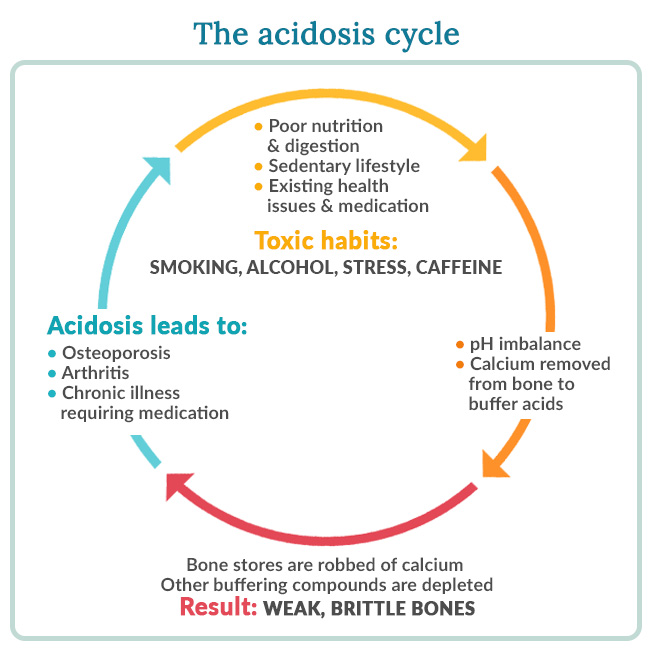
While our bodies can easily handle an occasional acid load, long-term acid build-up can exhaust our available alkalizing reserves. Unless we take steps to neutralize these acids, they can damage our health in many ways — and this is the underlying cause of many of our modern health problems, including osteoporosis.
Do you have signs of an “acidic” diet?
- Weight gain
- Nonspecific aches and pains, especially in the bones and joints
- Acid reflux or heartburn
- Poor digestion, irritable bowel, intestinal cramping
- Fatigue, feeling of being “run-down”
- Muscle weakness/loss of muscle
- Urinary tract problems
- Receding gums
- Kidney stones
- Bone loss
- Skin problems
- Low energy
How to start an alkaline diet ?
If you have three or more symptoms of acid imbalance (see above), eat 80% of your foods from the alkaline-forming group. The other 20% can be high protein items and other acid-forming foods. Later, when your pH balance has improved (which you can tell by urine testing or by the fact that your symptoms have resolved), you can lower the alkaline-forming part of your diet to around 65%.
Here are some general guidelines for eating an alkaline diet:
- Focus on eating whole foods, like vegetables, root crops, fruits, nuts, seeds, spices, whole grains and beans (especially lentils).
- Drink alkalizing beverages such as spring water and ginger root or green tea, water with the juice of a whole lemon or lime.
- Eat smaller amounts of essential fats, meat, fish, pasta and other grains.
- Eliminate processed and artificial foods, caffeine, white sugar and white flour.
- Don’t be afraid to use real butter, ghee and full-fat milk (if you use dairy).
- Dress salads or cook with high-quality fats such as cold-pressed virgin olive oil, coconut oil and avocado oil.
Alkaline diet plan: Sample day
We’ve put together a sample menu from our Alkaline for Life® meal plan to give you a sense of what you might eat if you’re trying to achieve an 80% alkaline diet. This “diet” doesn’t restrict calories or eliminate certain foods altogether (although you’ll have greater success if you avoid sugary foods and limit how much processed foods you eat). Calorie-counting isn’t part of this — you can eat as many alkalizing fruits and vegetables as you want, but you should limit things like meat, grains and highly processed foods to avoid boosting your acidity.
Breakfast: Veggie scramble: 1–2 eggs per person, scrambled with green onions, tomatoes, chopped bok choy or other leafy green, and bell peppers. Cup of ginger tea.
Snack: 1 pear and a handful (1 oz.) of toasted pumpkin seeds.
Lunch: Lentil soup served with 2 cups of steamed vegetables (broccoli, kale, carrots, onions). Drizzle olive oil salad dressing on lightly steamed vegetables. Or 4 oz. cold or hot salmon (or chicken, tuna or tofu), served over 2–3 cups mixed greens, tomatoes, cucumber, carrots, broccoli or other fresh vegetables. Lemon-dill vinaigrette.
Snack: Hard-boiled egg, sliced and sprinkled with sea salt and chopped flat-leaf parsley. Red bell pepper strips, celery or carrot sticks. A handful of almonds is also a snack option.
Dinner: 4 oz. serving of fish, chicken, turkey or other meat served with a baked yam or sweet potato and a mixed garden salad.
Vegetarian alternative: Pasta (made from buckwheat, rice, amaranth or quinoa rather than wheat) topped with bitter greens — such as broccoli rabe or arugula—plus chopped zucchini, pine nuts or slivered almonds, garlic, lemon juice and zest, salt, and pepper. Add a side dish of steamed zucchini with a dash of garlic and olive oil. (If you eat dairy, add a few pinches of grated pecorino Romano or fresh Parmesan, if desired.)
Dessert: Seasonal fruits make for a sweet finish to any meal: In summer, try nectarines and cherries, or grapes and melon; in winter, try roasted pears or baked apples. Ready to try an alkaline diet? I have made it easy to get everything you need to take a natural approach to bone health in my Better Bones Builder Program, including an alkaline diet guide, pH urine test strips and comprehensive nutritional supplements.