



By Dr. Mary James, ND
Don’t worry, I am not here to scold you for eating too many chips or cookies for comfort because, honestly, this isn’t the worst way that stress causes weight gain. Real adrenal stress weight gain comes from actual physiological changes that happen when your body is under chronic stress. Adrenal stress alters your hormones, setting your body up to pack on extra pounds.

A telltale sign of weight gain caused by adrenal stress is midsection weight gain. Stress-related belly fat is so difficult to lose once it appears because adrenal stress continuously “feeds” this fat, keeping it locked in place.
But here’s the good news — once you understand what’s going on in your body during long periods of stress, you will have ways to correct underlying imbalances so your body can finally let go of stubborn weight gain.
Let’s find out how this works.
Table of contents
- How chronic stress can make you fat
- What are the risks of stress and weight gain?
- Adrenal stress and fatigue cause belly fat
- Tips to control weight gain related to high cortisol
How chronic stress can make you fat
When the body is under stress, it shifts the way it physically handles incoming food. The stress hormones adrenaline and cortisol quickly mobilize energy production from carbohydrates and stored fats. But they also make the body less sensitive to leptin, the hormone that makes us feel full, so we inadvertently eat larger portions than normal.
There is nothing “wrong” with this chain of events – it’s simply part of our body’s innate “fight or flight” response that evolved long ago to help us to run for our lives, or stop and fight for survival.
The chronic stress of modern life is very different from stress our ancient forbearers faced, of course, but the body’s biochemical response remains exactly the same. So, unless you really do need to outrun a wild animal, your body doesn’t require all those extra calories for energy when you’re stressed and that’s why they get stored as fat.
Weight problems are standard for women in a state of constant stress, operating under elevated or high cortisol levels for very long periods of time.
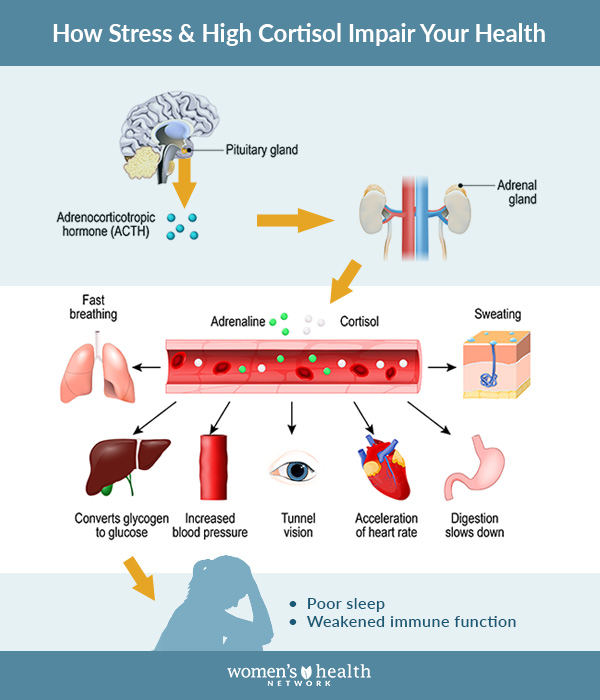
Cortisol is a key stress regulation hormone produced by the adrenal glands. When you’re in danger, your body is pre-programmed to release higher levels of the hormone. Cortisol helps to quickly boost your energy levels so you can react and flee imminent danger. Cortisol specifically helps:
- Regulate your blood pressure.
- Convert food into energy.
- Regulate the effects of insulin – the master hormone that controls your blood sugar levels.
- Reduce inflammation.
What are the risks of stress and weight gain?
When we live in a constant high-alert state, our cortisol levels remain unnaturally high and can cause all kinds of symptoms and long-term health problems.
Weight gain is often the most noticeable outward sign of chronic adrenal stress. But this isn’t just about your jeans feeling tight. Hormonally driven weight gain increases your risk for many serious health issues:
- high blood pressure
- insulin resistance and Type 2 diabetes
- joint pain
- infertility
- heart disease and stroke
- certain cancers
Adrenal stress and fatigue cause belly fat
Let’s zero in on belly fat for a minute because it is such a major part of adrenal stress weight gain.
Under normal circumstances when we haven’t eaten for a while, our blood sugar (glucose) drops and the brain sends a message to the adrenals to release cortisol to help out.
Cortisol maintains stable glucose levels in the blood by mobilizing stored glucose, amino acids and fat to prevent blood sugar from dropping too low, and to keep fueling your brain and body with energy in the absence of food.
But when we have long-term adrenal stress imbalances, cortisol levels are elevated in the blood and summon too much glucose. When glucose is not used for energy, it ends up stored in the form of fat — primarily abdominal fat cells. Scientists know that fat cells have special receptors for cortisol. That’s a problem because there seem to be more cortisol receptors on belly fat cells than anywhere else!
And sadly, belly fat doesn’t just “sit there” doing nothing. Incredibly, the fat itself becomes like an endocrine organ that reacts to the stress response, spurring still more abdominal fat to be stored.
3 tips to curb cortisol and adrenal stress weight gain
1. Eat well, and regularly
One powerful way to convince your body on a cellular level that it’s not going to starve to death just because you’re stressed is to eat nutritious food at regular intervals every day. Plan for and eat three balanced meals and two (also balanced) snacks per day. Spread them out across the day to work with your natural circadian rhythm.
Cortisol follows a natural cycle that complements your circadian rhythm. Normally, cortisol is highest in the early morning and declines gradually throughout the day to help you get ready for sleep. Because eating always bumps up cortisol, it’s ideal to eat your largest meal early in the day.
When it comes to snacking, many women are accustomed to loading up on sweets and caffeine because they’re comforting and so easy to access. (Hello, Starbuck’s drive-through!) But this habit often leads to an even greater plunge in energy.
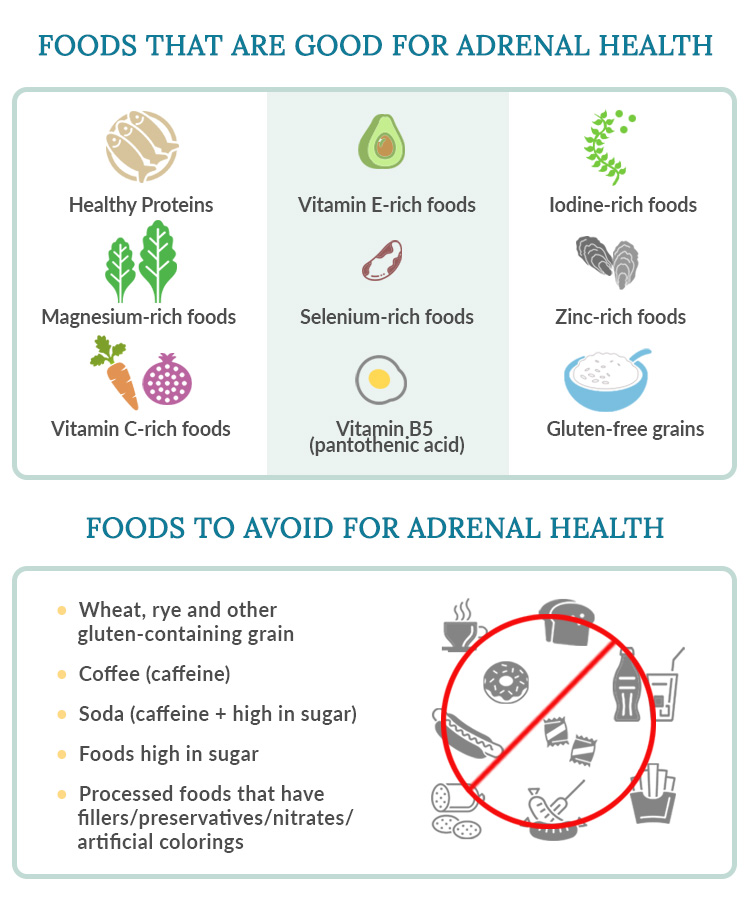
Instead when you need a boost, choose micronutrient-rich foods that support your adrenals, like asparagus, avocado, cabbage, garlic, ginger and lean protein.
Timing meals & snacks to support healthy cortisol levels & energy
2. Balance cortisol with phytotherapy
Using the right plant-based ingredients helps reduce the negative effects of cortisol. Astragulus root, rhodiola, cordyceps and passionflower are highly effective in resolving adrenal imbalances because they adapt to your body’s specific needs.
Along with phytotherapy, consider supplementing with a high-quality multivitamin mineral complex that you can count on to supply basic, everyday nutrients that you can’t live without. As adrenal expert, Shawn Talbott, PhD, confirms, “When it comes to dietary supplementation for stress adaptation and cortisol control, the first line of defense appears in the form of a comprehensive multivitamin/mineral supplement…”
3. Pace yourself to promote healing
If you’re tired, wired and overweight, try these ideas to lower your stress levels and heal your adrenal stress so you can stop the vicious stress/weight-gain cycle:
- Control the intensity of your exercise routine. If you already exercise regularly and feel good, keep it up. But if you feel exhausted all the time, ease up on the intensity to prioritize adrenal healing. And try to keep your heart rate under 90 beats per minute. If you don’t exercise, try walking 15 minutes once or twice a day, especially after meals.
- Check in on your sleep patterns. When your circadian rhythm is turned upside down, your cortisol cycle often follows, leaving you tired all day and wide awake all night. Have you felt like a “night owl” lately? You can reroute this pattern by eating earlier in the day, ending all screen time by 8 PM, and getting to sleep by 10 PM. Set aside a little time to wind down and leave 8 hours for actual sleep. If you are struggling with sleep, melatonin or Serinisol can help naturally reset your sleep cycle.
- Enjoy life and play. For once in your adult life, make having fun a priority! Many of us forget just how relaxing a few hours of joyful activities, or just a good laugh, can be. So today we are writing you a virtual prescription: Play today! (And do it tomorrow too).
- Stop and take 3-4 breaths. Taking a few deep breaths through your nose slows your heart rate and calms the whole body. Find time throughout your day just for these few breaths, especially when you feel stressed. You always have time to breathe more deeply, even if it’s just for 30 seconds.
When you resolve an underlying adrenal stress imbalance, it’s like a switch is thrown in the body that suddenly makes it possible to let go of the extra weight that your body has been holding on to for so long.
You can do this! By rebalancing your cortisol levels, you will not only be better able to stop and reverse adrenal weight gain, but you’ll feel better and more energetic as it happens!
1 Prentice, A., et al. 2008. Evolutionary origins of the obesity epidemic: natural selection of thrifty genes or genetic drift following predation release? Int. J. Obes. (Lond.), 32 (11), 1607–1610. URL (abstract): https://www.ncbi.nlm.nih.gov/pubmed/18852700 (accessed 04.10.2009).
Speakman, J. 2008. Thrifty genes for obesity, an attractive but flawed idea, and an alternative perspective: The “drifty gene” hypothesis. Int. J. Obes. (Lond.), 32 (11), 1611–1617. URL (abstract): https://www.ncbi.nlm.nih.gov/pubmed/18852699 (accessed 04.10.2009).
Speakman, J. 2007. A nonadaptive scenario explaining the genetic predisposition to obesity: the “predation release” hypothesis. Cell Metab., 6 (1), 5–12. URL (abstract): https://www.ncbi.nlm.nih.gov/pubmed/17618852 (accessed 04.10.2009).
2 Peeke, P. 2000. Fight Fat after Forty, 31–33. NY: Viking.
3 Dallman, M., et al. 2003. Chronic stress and obesity: A new view of “comfort food.” PNAS, 100 (20), 11696–11701. URL: https://www.pnas.org/content/100/20/11696.full (accessed 03.30.2009).
4 Margetic, S., et al. 2002. Leptin: A review of its peripheral actions and interactions. Int. J. Obes., 26 (11), 1407–1433. URL: https://www.nature.com/ijo/journal/v26/n11/abs/0802142a.html (accessed 04.09.2009).
5 Talbott, S. 2002. The Cortisol Connection — Why Stress Makes You Fat and Ruins Your Health, 25. Alameda, CA: Hunter House, Inc.
6 Wilson, J. 2001. Adrenal Fatigue: The 21st Century Stress Syndrome, 276. Petaluma, CA: Smart Publications.
7 Peeke, P. 2000. 31–33.
8 Chakravarthy, M., & Booth, F. 2004. Eating, exercise, and “thrifty” genotypes: Connecting the dots toward an evolutionary understanding of modern chronic diseases. J. Appl. Physiol., 96 (1), 3–10. URL: https://jap.physiology.org/cgi/content/full/96/1/3 (accessed 04.10.2009).
9 Kuo, Y., et al. 2009. Astragalus membranaceus flavonoids (AMF) ameliorate chronic fatigue syndrome induced by food intake restriction plus forced swimming. J. Ethnopharmmacol., 122 (1), 28-34. URL (abstract): https://www.ncbi.nlm.nih.gov/pubmed/19103273 (accessed 04.28.2009).
Mao, X., et al. 2009. Hypoglycemic effect of polysaccharide enriched extract of Astragalus membranaceus in diet-induced insulin resistant C57BL/6J mice and its potential mechanism. Phytomedicine, 16 (5), 426–425. URL (abstract): https://www.ncbi.nlm.nih.gov/pubmed/19201177 (accessed 03.10.2009).
10 Ji, D., et al. 2009. Antiaging effect of Cordyceps sinensis extract. Phyther. Res., 23 (1), 116–122. URL (abstract): https://www.ncbi.nlm.nih.gov/pubmed/18803231 (accessed 02.26.2009).
11 Zhou, X., et al. 2009. Cordyceps fungi: Natural products, pharmacological functions and developmental products. J. Pharm. Pharmacol., 61(3), 279–291. URL (abstract): https://www.ncbi.nlm.nih.gov/pubmed/19222900 (accessed 02.26.2009).
Ng, T., & Wang, H. 2005. Pharmacological actions of Cordyceps, a prized folk medicine. J. Pharm. Pharmacol., 57 (12), 1509–1519. URL (abstract): https://www.ncbi.nlm.nih.gov/pubmed/16354395 (accessed 03.16.2009).
12 Panossian, A., et al. 2009. Adaptogens exert a stress-protective effect by modulation of expression of molecular chaperones. Phytomedicine. [Epub ahead of print.] URL (abstract): https://www.ncbi.nlm.nih.gov/pubmed/19188053 (accessed 03.12.2009).
Liu, K., et al. 2008. Release of acetylecholine by syringin, an active principle of Eleutherococcus senticosus, to raise insulin secretion in Wistar rats. Neurosci Lett., 434 (2), 195–199. URL (abstract): https://www.ncbi.nlm.nih.gov/pubmed/18304730 (accessed 03.12.2009).
13 Olsson, E., et al. 2009. A randomized, double-blind, placebo-controlled, parallel-group study of the standardized extract shr-5 of the roots of Rhodiola rosea in the treatment of subjects with stress-related fatigue. Planta Med., 75 (2), https://www.ncbi.nlm.nih.gov/pubmed/19016404 (accessed 03.13.2009).
14 Pooja, et al. 2009. Anti-inflammatory activity of Rhodiola rosea — “a second-generation adaptogen.” Phytother. Res. [Epub ahead of print.] URL (abstract): https://www.ncbi.nlm.nih.gov/pubmed/19152369 (accessed 03.13.2009).
15 Kim, S., et al. 2006. Antioxidative effects of Cinnamomi cassiae and Rhodiola rosea extracts in liver of diabetic mice. Biofactors, 26 (3), 209–219. URL (abstract): https://www.ncbi.nlm.nih.gov/pubmed/16971752 (accessed 03.13.2009).
Kwon Y., et al. 2006. Evaluation of Rhodiola crenulata and Rhodiola rosea for management of type II diabetes and hypertension. Asia Pac. J. Clin. Nutr., 15 (3), 425–432. URL (abstract): https://www.ncbi.nlm.nih.gov/pubmed/16837437 (accessed 03.13.2009).
Further Reading
Hays, B. 2005. Chapter 19. Hormonal imbalances: Female hormones: The dance of the hormones. Pt. I. In Textbook of Functional Medicine. Gig Harbor, WA: Institute for Functional Medicine.