



Reviewed by Dr. Mary James, ND
When you have adrenal fatigue, the timing of your meals and snacks is remarkably important to how you feel during the day and how you sleep at night. A genuine adrenal fatigue diet focuses on changing when you eat as well as what you eat.

Table of contents
A lot of us skip meals or eat at erratic intervals when we’re under stress. Such inconsistency can be concerning because long periods without food can make the adrenals work harder by requiring them to release more cortisol and adrenaline to keep your body functioning normally. This can tire out your adrenals over time. Not to mention, it makes you hungry enough to forget your good intentions to eat healthy and causes you to just grab whatever you can — whether it’s good for you or not.
That’s why on our adrenal fatigue diet, you’ll never get too hungry or deprive yourself of delicious food. Your adrenals need fuel, and that means a routine of regular meals and snacks with a variety of real foods is an absolute must — unlike many diets, which demand that you fast or deprive yourself!
Our simple guidelines help you build an eating plan that supports your adrenals and fits in with your lifestyle. It helps you identify the best times for you to eat, the nutrients you need (and may not be getting) and what foods to avoid. This knowledge will help transform your adrenal health so that you can feel energetic all day and get a great night’s sleep.
Adrenal fatigue diet meal plan and when to eat
Eating for adrenal health starts with supporting your body’s natural cortisol cycle — which in turn reduces the stress on your adrenals. The goal is to prevent most of the dramatic spikes in cortisol that are triggered when you go too long without eating. Over time, unstable or high cortisol levels can cause very unpleasant adrenal fatigue symptoms and alter your natural cortisol curve.
Our recommended meals schedule for a stable cortisol level
To keep your cortisol levels as smooth as possible, eat three nutritious meals and two to three snacks throughout the day.
Here is the schedule that we recommend:
- 8:00 AM
- 9:00 AM
- 11:00 AM – noon
- Between 2:00 – 3:00 PM
- 5:00 – 6:00 PM
- An hour before bed
Working with your natural cortisol cycle – timing meals and snacks to support healthy cortisol levels & energy
Cortisol levels follow a natural cycle that aligns with your circadian rhythm. Normally, cortisol begins to rise around 6:00 AM and reaches its highest peak around 8:00 AM. Throughout the day, cortisol gradually and naturally declines — with small upward bumps at mealtimes — to prepare your body for nighttime rest. You can see in the chart below why timing your meals and snacks can help balance cortisol levels.

If you can’t stick to the recommended timing for meals and snacks every day, keep these guidelines in mind:
Breakfast: Women tell us they often don’t feel hungry in the morning. But having a nutritious breakfast within an hour of rising energizes your metabolism and supports your cortisol levels throughout the day. Include a little protein to make sure it sticks with you — an egg, some yogurt or even refried beans are good options.
Lunch: Eating your largest meal in the middle of the day helps keep cortisol in balance. Lunch is often rushed or gobbled down at a desk between work tasks. Instead, take plenty of time to eat, and choose a more relaxed setting if possible. Tranquil mealtimes are essential for good adrenal health.
Dinner: Try to eat an early dinner (by 5:00-6:00 PM). If this is just too early to accomplish, you can at least make your evening meal the lightest one of the day. Many women tell us they tend to overeat at dinner and before bed. Unfortunately, a full stomach and the stress hormones it triggers can prevent restful sleep (resulting in higher stress hormones the next day).
Meal and snack times are meant to be an enjoyable and relaxing event, not rushed. Practice mindfulness as you eat by focusing on the flavor and texture of your food. Shut off your phone and email during meals and snacks — you don’t need to feel more stress as you eat! If you still feel hungry after a light meal, don’t eat more; instead, drink water or tea to both fill your stomach and hydrate you overnight.
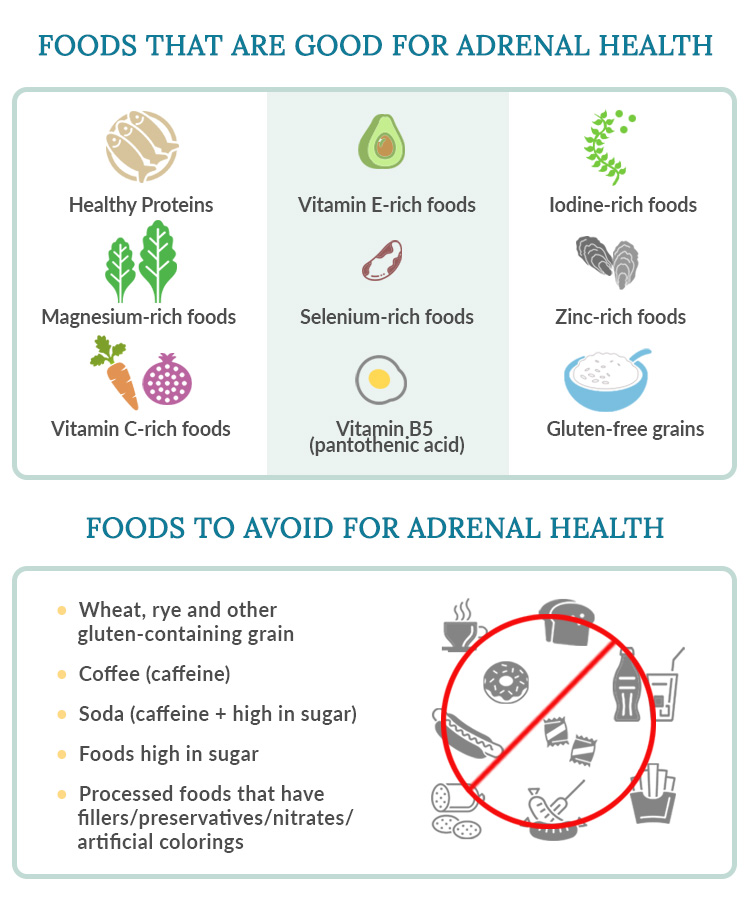
What to eat and what NOT to eat for adrenal health
Stress often exposes our worst food choices. We reach for foods and drinks for instant energy and the brief moments of comfort — cookies, doughnuts, coffee or soda. But craving sweets perfectly makes sense — it’s your body’s normal response to low blood sugar.
Unfortunately, the surge of energy from these foods is followed by a plunge in energy and you end up feeling worse very quickly. Sugar and simple carbohydrates stimulate a spike in blood sugar and a subsequent surge in insulin that clears sugar from your bloodstream so fast that you “crash.” Complex carbohydrates don’t cause this same spike-and-crash cycle, though too many carbs in general will still imbalance blood sugar.
5 ways to support your adrenal healing with better food choices
- Include protein. Protein in all of your meals and snacks will have a stabilizing effect on your blood sugar, which, in turn, can help you overcome cravings for caffeine and sugars. Nuts, seeds, beans and other plant proteins are good choices. Women typically need between 60-70 total grams of protein per day. Protein is especially important to get you started in the morning.
- Give gluten-free foods a try. As you begin to balance your adrenals, stay away from any form of wheat, rye or other gluten-containing grains. Many people have inflammatory reactions to gluten. Turn to gluten-free grains like wild rice, quinoa, “pure” buckwheat and amaranth and see how you feel. If you later reintroduce gluten and find that symptoms return, you may want to cut it out altogether.
- Limit caffeine’s effects. Caffeine can overstimulate the adrenals and disrupt sleep patterns. But if you find yourself craving caffeine, it may be that your cortisol or blood sugar is low or that serotonin is imbalanced. Either way, you may not have much energy and your body probably needs rest. Instead of cranking it up with another cup and having a caffeine crash later, take a mini-break and try deep breathing or a 10-minute walk.
- Eat as “clean” as possible. Whenever possible, eat fresh, whole foods, preferably organic or locally grown, without colors, dyes, chemicals, preservatives or added hormones. And when you can’t do this, make sure you drink plenty of water — it will help your body flush out the unwanted chemicals.
- Notice your salt cravings. Women with adrenal fatigue often crave salt. Yes, salt can increase blood pressure, but low blood pressure (hypotension) is a very common sign of adrenal insufficiency. If you feel lightheaded when you get out of bed in the morning, stand up quickly or get up out of a bath, you may very well have low adrenal function. Including more good quality iodized sea salt in your diet could be helpful.
Nutrients you need for adrenal health
Common symptoms like stress and weight gain, irritability and fatigue are often related to nutrient deficiencies. This list of the top nutrients you need for adrenal health helps you understand why they are important and which foods are good sources. You may also want to consider a comprehensive multivitamin/mineral formula such as our Essential Nutrients.
| Nutrients for adrenal health | Good food and snack sources |
|---|---|
| Vitamins C, E and all B vitamins (especially pantothenic acid and B6) have crucial roles in the production and actions of stress hormones. | Vitamin C: red and orange fruits and colorful vegetables.
Vitamin E: avocados, hazelnuts, almonds, seeds, spinach and asparagus. Vitamin B6: Brewer’s yeast, sunflower seeds, wheat germ, fish (tuna, salmon, trout), liver and beans. |
| Magnesium provides necessary energy for your adrenals — and every cell in your body — to function properly. | Magnesium: dark green leafy vegetables, fish, nuts, seeds and whole grains. It’s hard to get enough just from diet, so supplement with +/- 500 mg daily. |
| Calcium and several trace minerals, like zinc, manganese, selenium and iodine produce calming effects in the body, which will help restore normal cortisol levels. | Calcium: dairy foods, dark leafy greens and soy.
Zinc: fresh oysters, sardines, beef, lamb, turkey, soybeans, split peas, whole grains and sunflower seeds. Manganese: whole grains, nuts, leafy vegetables and teas. Selenium: Brazil nuts, tuna, organ meats, mushrooms, halibut, beef, soybeans and sunflower seeds. Iodine: sea vegetables and seafood (clams, shrimp, haddock, oysters, salmon, sardines), as well as iodized sea salt. |
Small changes, dramatic adrenal differences
Starting to eat in a new way can feel stressful, so focus most on making the best choices you can — you don’t have to be perfect. Go easy on yourself, as we all veer off the nutritious path occasionally.
With your knife and fork, you have the power to lessen the burden on your adrenals — and your whole body. It doesn’t take much — just some small shifts in the choices you make in your nutrition and eating patterns will make a big, happy difference.
1 Wilson, J. 2007. “Assessment of adrenal function: Integrating laboratory and symptoms.” IFM 14th International Symposium, 05.27.2007, Tucson, AZ.
2 Wilson, J. 2001. Adrenal Fatigue: The 21st Century Syndrome. Petaluma, CA: Smart Publications.
3 Takeda, E., et al. 2004. Stress control and human nutrition. J. Med. Invest., 51 (3–4), 139–145. URL (full text): https://www.jstage.jst.go.jp/article/jmi/51/3,4/51_139/_article (accessed 04.29.2008).
4 Mitchell, P. 1992. Effects of caffeine, time of day and user history on study-related performance. Psychopharmacology (Berl), 109 (1–2), 121–126.
5 Burchfield, G. 1997. What’s your poison? Caffeine. URL: https://www.abc.net.au/quantum/poison/caffeine/caffeine.htm (accessed 06.08.2006).
6 Stansbury, J. 2007. “Helping the stressed adrenals: Dietary, nutritional, and botanical supplementation.” IFM 14th International Symposium, 05.25.2007, Tucson, AZ.
Further reading on the connections between nutrition and adrenal fatigue
Adrenal Fatigue, the 21st Century Stress Syndrome, by James Wilson. An excellent and up-to-date introduction to the pathways of chronic stress, adrenal fatigue, adrenal exhaustion, and how nutrition can support adrenal function and healthy cortisol levels.
The Relaxation & Stress Reduction Workbook, by Martha Davis.
The Cortisol Connection: Why Stress Makes You Fat and Ruins Your Health, by Shawn Talbott & William Kraemer.
The Relaxation Response, by Herbert Benson, MD. An updated version of the classic text.
The Schwarzbein Principle II, Dr. Schwarzbein’s second book, explores more deeply the relationship between adrenal stress and insulin resistance.
Dalvi, S. 2003. Adrenal Fatigue: A Desk Reference. Sandy Beds, UK: Authors Online.