


With the influx of so many new kinds of soy foods to the market today, from soup to nuts, choosing which ones to add to our diets can be confusing. And with so much soy hidden in not-so-healthy foods we sometimes like to eat — like doughnuts! — it seems impossible to keep track of the coming and going of the soy we’re eating. Some may wonder if including soy foods is worth the bother, or if they should even avoid them.
In this article, we hope to give you some answers about the nutritional qualities and health benefits of soy.
We want you to known that soy foods have gotten mixed reviews over the years. But frankly, we have often wondered where the intense feelings and emotional fervor about this humble green bean come from!
Many patients are looking for alternatives to hormone replacement and are curious about soy foods, soy supplements, soy isolates and phytoestrogens, but don’t know where to start. Although soy may not be helpful for all women in this regard, we have found that adding soy can provide health benefits during perimenopause and menopause.
Soy as a food
As we walk the aisles of our grocery stores, health food stores and farmer’s markets, faced with a choice between traditional and nontraditional soy foods, we may wonder where the best soy can be found. We know from historical accounts that soybean curd (tofu) was used in China by all ranks of society, from peasants to royalty, as a household staple. For 5000 years it has been considered one of the five sacred plants — the others being rice, wheat, barley and millet. We know that soy is high in nutritional value as a non-animal source of eight of the essential amino acids, which makes it the only complete plant protein. Whole soy foods also are a good source of fiber, B vitamins, calcium, and omega-3 fatty acids.
| Soy foods come in all shapes and sizes | |
|---|---|
| For those of you inclined to experiment in the kitchen, opportunities abound to add soy protein to your diet. | |
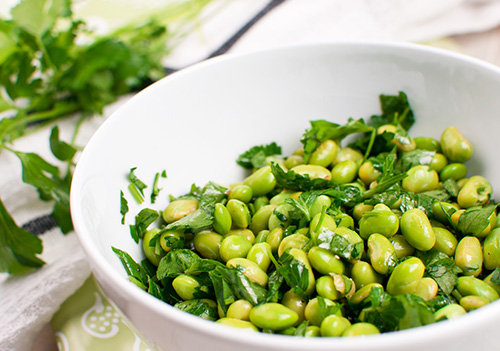
| Edamame is the Japanese name given to the small, green (not quite mature) soybean. Most often found in the frozen food section, shelled or unshelled, edamame can be boiled, steamed or eaten raw as a snack. With a sweet taste similar to green peas or artichokes, edamame can be served as a hot side dish like peas or corn, or used in soups, salads and stir-fries. | |
| Tofu is made from soymilk that is curdled with mineral salts. The liquid is drained and the remaining curd pressed into a custard-like cake. Tofu comes in many varieties, from extra-firm to silken soft. Its texture may take some getting used to, but tofu is a very versatile food that absorbs the taste of the ingredients mixed with it. Tofu can be used in casseroles, stir-fries, and egg dishes, and adds good plant protein. We know women who add tofu to anything and everything — from cereals, cottage cheese, scrambled eggs, and spaghetti, to kebabs, fruit dishes and puddings. Many supermarkets are now selling marinated tofu that has a denser, more flavorful consistency that many people prefer. Tofu can also be substituted for cream cheese in dips, bagel toppings or other recipes. | |
| Soy milk doesn’t come from a soy cow, but is processed from the bean itself. Different manufacturing processes produce soy milk with varying levels of protein and fat — the greater the protein content (generally at least 4%) the higher the isoflavone content. Fat content usually ranges from 1–3%. All soy milk is lactose- and cholesterol-free. Most soy milk is now fortified with calcium, vitamin D and other nutrients, and many flavors are available. Soymilk can be packaged in aseptic cartons with a shelf life of a year or kept refrigerated like cow’s milk. Plain soy milk powder can be used for baking, but unless it has been sweetened does not usually make a very palatable drink. | |
| Soy cheese is made from tofu and loses much of its nutritious value in processing, but is nonetheless a good non-dairy alternative. | |
| Tempeh is an Indonesian soybean product that has been inoculated with a mold then incubated. It may sound gross, but tempeh is one of our favorite fermented soy foods. In America, tempeh is usually sold refrigerated or frozen and often used as a meat or poultry substitute. It can be marinated, baked, grilled or deep-fried. | |
| Miso is a Japanese fermented soybean and grain paste that is used as a soup base, similar to bouillon cubes but without the nasty food additives. Miso is salty, but again very nutritious and valued for its digestive properties. | |
| Soy flour is ground from whole or shelled soybeans into a fine powder, and is best kept refrigerated to retain freshness. Soy flour can be used for thickening and in baking, but because it contains more moisture and is gluten-free it does not produce equivalent results, so some modifications have to be made when substituting it for wheat or other flours. | |
| Soy nuts are shelled soybeans that have been dried and roasted until crunchy. Soy nuts are lower in fat than other snack nuts and are sold salted or spice-flavored — even candied. | |
| Soy protein isolate is soy protein processed from defatted soy flakes or soy powder. The powder is 90% pure protein, very bland and highly digestible. Soy protein isolates are easily added to shakes, smoothies and other recipes to make a creamy texture. Plain or flavored versions are available and can be kept without refrigeration. | |
| Textured soy protein is a processed form of soy flour and water, which is used primarily as a meat substitute in ground meat dishes, stews, and kebabs. Textured soy protein is sold in granules or chunks, has less fat than tofu, and should contain no other additives. | |
| Soy sauce and tamari/shoyu are fermented soy products that lend a richer flavor to many Asian recipes. The label should state that it contains only soybeans, salt, water and sometimes wheat — no hydrolyzed vegetable protein (HVP) or caramel coloring. “Lite” refers to lower salt content. | |
Soy researcher Mark Messina notes that around 30% of women between the ages of 20 and 69, and 40% of women over the age of 70 are getting less than the recommended dietary allowance for protein. Soy foods provide high-quality protein and are low in saturated fat. He also notes that back in the early 1900’s, our diets consisted of somewhere around 70% plant protein and 30% animal protein. Today, it’s more like 50:50. Since soybeans are 38% protein, which is very high for a bean , they make a great choice for women who want to increase the quality protein in their diet — specifically plant proteins.
Soy has been the protein of choice for many vegetarians and nutritionists for many years. Cookbooks from the Moosewood Restaurant, among other vegetarian cookbooks, abound with soy recipes, and many people of all ethnicities enjoy soy as a regular part of their diet with seemingly little to no ill effect. From the China Study to the Okinawa Plan, more and more people are waking up to the power of the plant-based Asian diet in improving health and longevity.
Soy isoflavones — whole beans are best
Isoflavones are one branch of a family of chemical compounds, called phytochemicals, found in all plants and legumes, including beans, green leafy vegetables, yellow and orange vegetables and whole grains. A diet rich in a range of phyto- (Greek for plant) chemicals is the foundation of a healthy complete diet.
For you to glean the best from the vast fields of soy grown in this country, always look for labels that say “Non-GMO.” It is quite possible that the pesticides used on soy (beans that are eaten directly or eaten by livestock) may bioaccumulate in our tissue and cause problems. But this is not a soy-isolated problem, which is why we also eat organic where practicable. Soy is a cash-making crop in the US, and some varieties have been genetically modified to increase yields. Scientific data is conflicting on the long-term health effects of eating genetically-modified foods, but it is our preference to avoid them whenever possible.
While still controversial in some circles, we’ve studied the scientific literature on isoflavones in some depth, and feel confident that their health benefits outweigh any hypothetical harm they could cause — unless you have a thyroid problem.
Soy: How much am I already getting, how much should I add?
Calculating healthy daily serving sizes, grams of proteins, and milligrams of soy isoflavones may be a bit mind-boggling. But you don’t need a math degree if you remember that for the cardiac benefits of soy, you need two to four servings a day to get the suggested 25 grams of protein. One serving (see chart) is equivalent to a cup of soymilk, a half-cup of tofu (about one-third of a block), or one-quarter cup of soy nuts.
While many women are looking to add soy foods to their diets, others wonder how much hidden soy there is in our foods. It’s true the US is the world’s second-largest grower of soybeans, and soy is turning up everywhere in our industrial food chain, from store-bought packaged goods to fast foods, bakery items to livestock feed. So it surprised us to learn how in 2000, the Californian women in one study were getting as much as one-fifth of their total soy isoflavones from doughnuts! Despite soy’s wide availability, most people here in the West still eat relatively very little of it: only 0.15 to 3.0 mg/day of isoflavones, according to some reports.
There is also a lot of soy oil being used in fried foods, snacks and commercial salad dressings. We wish we could say that was a good thing, but let us explain why it probably is not. Even though soybean oil is a polyunsaturated fat, we don’t recommend eating a lot of it, and don’t consider it a healthy cooking or salad oil because it contains more of the types of fatty acids that most of us get too much of. Unfortunately, this favors inflammatory processes in our cells .
Despite the many delicious soy foods around (over 1,600 food products are available in the US alone), it may be difficult for you to get the 80 mg per day of soy isoflavones — the amount considered helpful for hormonal imbalance — from your diet alone. Or you may not like the taste or texture of soy. In this case, you may want to investigate other sources of soy including soy supplements and functional foods. We’ve found that soy shake made with whole, non-GMO soybeans are often useful. Talk to your practitioner about her or his recommendations. Soy protein shakes and bars taste good and can be an easy way to boost your daily intake.
Only part of the story
As long as people continue to eat and enjoy soy products, the key, as with everything we recommend, is balance. While it is entirely possible that there are people out there who reap tremendous health benefits from soy, there are others who may not — the majority, however, just need to look East to see that a varied diet that contains some quality soy is fine.
First and foremost to listen to your body. If you do well with soy products, chances are you are metabolizing and tolerating them effectively. If you react negatively to soy, you can try digestive enzymes and a probiotic supplement, you can try a detox diet, or you can avoid it. As in all things, practice being an informed consumer when purchasing soy products, and do so in moderation. Eat a varied and nutritious diet, filled with lots of fruits and vegetables, minimally processed foods, and healthy fats — and, of course, a little chocolate now and then.
Don’t think of soy as an additive to one’s diet (it does contain calories). And don’t think of it as a magic cure-all or easy treatment for all health woes — remember, even in the natural world there is no magic bullet. Soy is a great food and can be effective in supplemental form, as well, but only as a part of a much larger and robust whole. Get to know yourself, get to know soy, talk to your practitioner and then trust yourself to make the right decision for you.
Balk, E., et al. 2005. Effects of soy on health outcomes. Evidence Report/Technology Assessmenet No. 126. (Prepared by Tufts–New England Medical Center Evidence–based Practice Center under Contract No. 290-02-0022.) AHRQ Publication No. 05-E024-2. Rockville, MD: Agency for Healthcare Research and Quality. URL: https://www.ahrq.gov/downloads/pub/evidence/pdf/soyeffects/soy.pdf (accessed 01.26.2006).
Barnes, S. 2004. Soy isoflavones — phytoestrogen and what else? J. Nutr., 134 (5), 1225S–1228S. URL: https://jn.nutrition.org/cgi/content/full/134/5/1225S (accessed 01.31.2007).
Henckel, J. 2000. Health claims for soy protein; questions about other components. FDA Consumer Magazine. URL: https://www.fda.gov/fdac/features/2000/300_soy.html (accessed 01.31.2006). [This is a good summary of the FDA health claim.]
Klemola, T., et al. 2002. Allergy to soy formula and to extensively hydrolyzed whey formula with cow’s milk allergy: A prospective, randomized study with a follow-up to the age of 2 years. J. Pediatr., 140 (2), 219–224.
Sacks, F., et al. 2006. Soy protein, isoflavones, and cardiovascular health. An American Heart Association Science Advisory for professionals from the Nutrition Committee. Circulation. Published online before print, 01.17.06. URL: https://circ.ahajournals.org/cgi/content/abstract/ CIRCULATIONAHA.106.171052v1 (accessed 01.31.2006).
Casini, M, et al. 2006. Psychological assessment of the effects of treatment with phytoestrogens on postmenopausal women: A randomized, double-blind, crossover, placebo-controlled study. Fertil. Steril., 85 (4), 972-978.
Further Reading
Daniel, K. 2005. The Whole Soy Story. Winona Lake, IN: New Trends Publishing, Inc.
Jacobi, D. 2001. Amazing Soy: A Complete Guide to Buying and Cooking This Nutritional Powerhouse with 240 Recipes. NY: Morrow Cookbooks.
Messina, M., & V. Messina. 1994. The Simple Soybean and Your Health. Wayne, NJ: Avery Publishing Group.
Oser, M. 1996. The Soy of Cooking: Easy-to-Make Vegetarian, Low-Fat, Fat-Free, and Antioxidant-Rich Gourmet Recipes. Hoboken, NJ: Wiley.
Websites
Cancer Nutrition Info’s site has a good list of references. URL: https://www.cancernutritioninfo.com
Revival Soy’s benefits & research page: https://www.revivalsoy.com/whysoy/