

Insulin resistance
What you need to know about insulin control and nutrition
One thing we know for certain about insulin resistance, diabetes, and metabolic
syndrome is that they are intimately related to nutrition. At Women to Women, we
regard insulin resistance as the perfect opportunity to make changes in your diet
that can keep blood glucose stable. But having diabetes makes it mandatory to do
all the things we encourage women to do anyway, especially eating balanced meals.
We are all well-served when we eat from the four food groups, by choosing fresh
colorful vegetables and fruits, whole grains, and rich sources of protein and healthy
fats (as well as avoiding heavily processed foods such as high-fructose corn syrup
and trans fats). Balance is as essential in diabetes as it is in overall health
— it’s just that it’s no longer an option!
To underscore the importance of balance in controlling blood glucose, we’ve
compiled an overview of the four food groups — protein, fat, complex carbohydrates,
and fiber — and encourage you to include them in all your meals and snacks
daily.
Keep in mind as you read below that in terms of energy, the two hormones that are
most influential when it comes to what we store in our bodies and what we use are
insulin and glucagon. In broad terms, you can think of insulin
as the “storer” of nutrients and glucagon as the “mobilizer”
of nutrients. Insulin opens cell doors to take glucose out of the blood stream and
shuttle it into your cells, while glucagon stimulates the release of glucose into
the blood stream.
Proteins
Protein is essential for life. We use it to build and repair our bodies (including
our bones, cells, muscles, enzymes, hair, nails, hormones, and neurotransmitters).
We use it to help us burn fat and help fight off infection and inflammation.
When your blood sugar is low before eating, your pancreas releases a hormone called
glucagon, whose main purpose — in contrast to insulin’s — is to
mobilize stored glucose and prevent hypoglycemia. Eating a very protein-rich meal
will also cause your pancreas to release glucagon, which is why high-protein diets
work for a while in helping people lose weight. But a gentler way to support lasting
weight loss is by not going whole hog on proteins, but not scrimping on them, either.
By including some protein in all your meals and snacks you can even out the see-saw
action between insulin and glucagon. Protein will help counterbalance the surge
of insulin caused by the carbohydrate content in your meals, which in turn helps
prevent your body from hoarding the energy in the sugars, storing it in your cells,
or converting it to fat.
The average woman needs to consume about 60–70 grams of protein a day —
but counting up your grams of daily protein isn’t really necessary unless
you think you’re not getting enough or, on the other hand, overdoing it. Good
sources of animal protein include eggs, fish, poultry, lean meats and cheese. But
protein sources are also found abundantly in the plant world, in seeds, nuts, legumes,
and soy foods such as tofu, tempeh, and soy milk, and there is strong evidence to
suggest that we would all enjoy better health and hormonal balance by upping the
plant protein and cutting back on the animal protein in our diets. Another way to
boost protein intake is by combining whole grains with any of the above-listed protein
sources in your meals and snacks.
Fats
Like protein, fat is essential for life. It is an integral part of every cell membrane
in our bodies and comprises about a third of our brains. So despite any recent fads
in low-fat dieting, it is clear that eating fat is fundamental to health and well-being!
Among its many roles, fat is crucial to maintaining adequate hormonal balance, stabilizing
blood sugar, increasing immunity, supplying energy, and controlling hunger.
How does fat help to regulate hunger? One of the key players in satiety,
or that lovely sense of satisfaction we get from our food, is cholecystokinin
(CKK), a peptide hormone that triggers a sense of fullness. When we eat fat, our
intestinal and stomach walls secrete CCK, which helps with the digestion of fat
and protein. This kicks in about 8–20 minutes after we begin to eat, particularly
when there is good fat and/or protein content in the meal. Again, the release
of this hormone in the stomach and intestines is triggered by fat and protein content
in our food. CKK apparently stimulates the vagus nerve with a message to
“stop eating” and also helps turn off ghrelin, the hormone
of appetite, which triggers the sensation of fullness.
Whenever you feel hungry between meals you can test this mechanism by eating a small
handful of nuts, such as almonds or walnuts, to trigger the release of CCK. Within
20 minutes you should note the hunger pangs abate!
Fat also slows down the processing of food in your digestive tract, which means
that by including it in your meals and snacks you lower the overall glycemic load.
This makes for steadier blood sugar levels over time and nice long-lasting satisfaction
after eating.
But just as it’s important to recognize that fat is good for you,
it’s important to eat healthy kinds of fats — natural fats. There are
three kinds of natural fats: saturated, monounsaturated, and polyunsaturated. All
three of these fats are okay to eat because they are natural and your body can digest
them, but it’s the polyunsaturates that rank as stars in maintaining
health.
Damaged fats, including oxidized or rancid fats, trans-fatty acids and hydrogenated
fats, are what you should take care to avoid. These are fats whose chemical structures
have been altered in such a way that your body cannot metabolize them. These fats
build up as cellular debris and can eventually damage cells and disrupt their function.
In a study published in 2001 of nearly 85,000 women followed over 14 years, it was
found that trans-fatty acids increase and polyunsaturated fatty acids reduce
risk of type 2 diabetes. The authors concluded that substituting nonhydrogenated
polyunsaturated fatty acids for trans fatty acids in the diet is likely to reduce
the risk of type 2 diabetes substantially. Although no direct causal link between
the effects of trans fatty acids and diabetes was identified, in the presence of
underlying insulin resistance, researchers felt trans fats increase the probability
of developing clinical disease.
As an aside,we’d like to think that the publication of this study in 2001
is helping to break the pattern the food industry has of loading commercially produced
foods with damaging trans fats. Although we’ve known since the 1970’s
that trans fats are bad for us, they remain common in prepackaged and processed
foods such as brand name peanut butters, margarines, non-dairy creamers, imitation
mayonnaise, deep fried foods, and fast foods.
It’s interesting that it has taken over 30 years for fast-food chains such
as McDonald’s and Kentucky Fried Chicken to agree to eliminate them from their
menus. Even so, the food industry is permitted to label foods with “zero trans
fats” if they contain less than a gram per serving. So be sure to check the
labels for serving size — if you see they’re really small, they’re
probably hiding something. The December 2006 decision by the people of New York
City to ban these artery-clogging fats altogether from their streets shows us that
given adequate information, people are prepared to take their health into
their own hands. One more good reason to love NYC!
Carbohydrates
Carbohydrates are recognized by our bodies as sugar that gives us immediate energy.
Carbohydrates stimulate the release of insulin, and if they’re not used right
away as fuel, they’ll be stored as fat in your body. So it is important to
think about your activity level when consuming carbs.
Unlike fat and protein, carbohydrates may not trigger a signal to your brain that
you are full. What that means if your meal is high in carbs, but contains little
to no fat or protein, is that less CKK gets released as you begin to eat. So Mother
Nature’s in-built satisfaction mechanism is less likely to kick in and do
its job, and you are more likely to continue to eat, or overeat, without feeling
satisfied! Moreover, a high-GI meal may result in a return in your body of high
levels of ghrelin sooner than do meals containing adequate protein and fat, so you
are likely to feel hungry again sooner.
But don’t let this information tempt you to avoid carbs altogether. Why not?
Because eating a diet with zero carbohydrates causes insulin levels to drop even
further, which not only starves the cells of energy (the very situation diabetics
are trying to avoid), but upsets the insulin–glucagon balance. This can lead
to depression, fatigue, insomnia, and bone loss. Additionally, our brains need glucose
from carbohydrates to function properly.
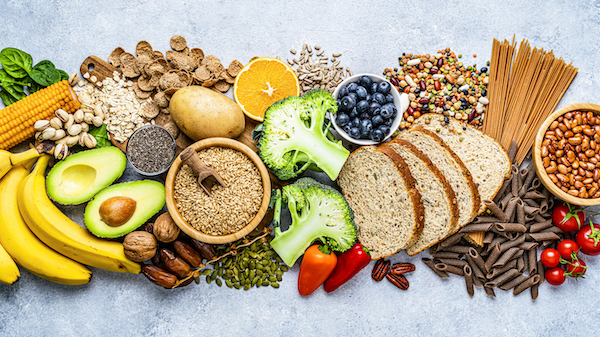
To keep your insulin–glucagon ratio balanced, it is important to consume carbohydrates
with a low glycemic index (GI). This means eating carbs found in whole grains, fruit
and vegetables — known as complex carbohydrates. Complex carbohydrates break
down more slowly in the digestive tract, resulting in a less dramatic surge in blood
sugar levels and more efficient metabolism.
Fiber/non-starchy veggies
Non-starchy vegetables contain fiber and loads of important vitamins, minerals,
and micronutrients for your body. These micronutrients hold information that speaks
to your cells and genes to keep all your systems in balance — including the
endocrine system, whose main players are insulin and glucagon. Because of their
low glycemic index, it isn’t necessary to keep track of the carbohydrates
you are consuming while eating non-starchy vegetables. There is an endless variety,
color, and texture to choose from this group: eat as many as you like — the
more the better!
By planning to include each of the above food groups in your meals and snacks, you
can regulate your blood sugar levels better and supply your body with the abundant
raw materials it needs to constantly rebuild healthy cells, tissues, and organs.
Our Personal Program is a great place to start
The Personal Program promotes natural hormonal balance with nutritional supplements,
our exclusive endocrine support formula, dietary and lifestyle guidance, and optional
phone consultations with our Nurse–Educators. It is a convenient, at-home
version of what we recommend to all our patients at the clinic.
If you have questions, don't hesitate to call us toll-free at
1-800-798-7902. We're here to listen and help.
Related to this article:
References & further reading
on insulin control and the 4 food groups
Last Modified Date: 05/26/2011
Principal Author: Amy Amoroso