

Heart disease in women: a new understanding
by Marcelle Pick, OB/GYN NP,
and Dixie Mills, MD
Heart disease is the leading cause of death among American women. But in 25 years
of medical practice we have never had a patient suffer a heart attack.
How can both these facts be true?
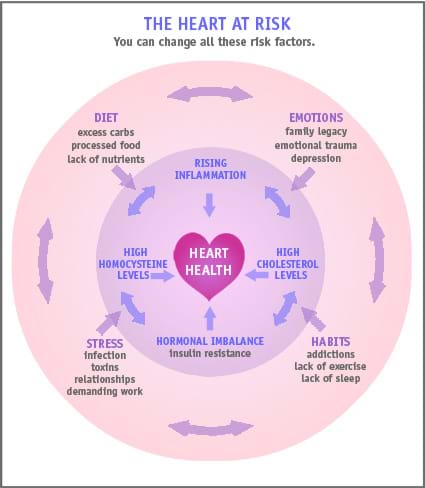
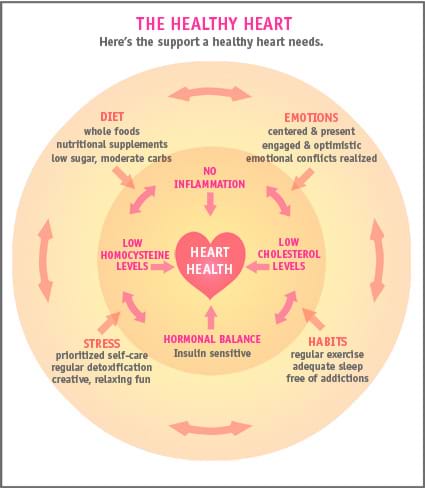
The simple answer is that at Women to Women we advocate an approach to life that
supports the heart. We look at health, including your heart and arteries, from a
holistic perspective that takes into account all of the factors that create health
or disease, especially your diet, lifestyle, genetics and emotions.
Consider Ellen. When I first saw Ellen her cholesterol levels were 450 (more than
twice the acceptable range). This was just after her divorce, and she told me she
felt “heavy-hearted.” She was afraid statins would mean a lifetime of
medication, but she was also afraid of having a heart attack. So she followed our
dietary guidelines instead, and after two months her cholesterol levels were down
to 180. She then had the energy to deal with the emotional baggage that was —
literally and physically — blocking her up. She’s healthy and vigorous
to this day.
Tips for Personal Program Success
Warm up, cool down. Be sure to give yourself at least 5 minutes on either end of your workout to get your muscles loosened up. This helps prevent injuries, feels great, and helps your muscles elongate and restore balance.
What does this mean for you? We think that conventional medicine is moving in the
direction of our approach, but it may not get there in your lifetime — or
ours! So we want you to understand what determines your heart health, the virtues
and shortcomings of conventional medicine, and how you can adopt our holistic approach.
Every woman has choices to make that affect her risk of heart disease, particularly
as she ages, but it’s important to know that you have a great deal of control
over the outcome. Like Ellen, you can be your own hero when it comes to your heart.
Here are the resources for you in this section of our website. Take a moment to
browse among these articles for the information that most supports you and your
heart.
Our most popular resources on heart disease
To access an article, just choose from the list of excerpts below. To find more
articles, use the search function below. Don’t see a topic that’s important
to you? Let us know.
-
Preventing
heart disease naturally.
There is so much you can do to improve your heart health naturally and reduce the
risk of heart disease. By following our simple seven-step guide you can choose health
and nurture both your heart and soul.
-
Hypertension in women.
Though not generally thought of as a woman’s disease, the incidence of hypertension
in women has increased sharply in recent years. In this article we explain some of
the reasons why this is happening now, how the body modulates blood pressure, the
causes and effects of high blood pressure, the limitations of conventional treatment,
and how to prevent and treat high blood pressure naturally.
-
Cardiovascular diseases and conditions.
Many of the names and terms used to describe heart conditions sound similar, and
the conditions themselves are often interrelated. Here is a listing of the most
common cardiovascular diseases and conditions with some brief descriptions.
- Risk factors for heart disease.
Although there is no simple test to predict heart disease — just as there
is no single cause — there are several factors that indicate a greater likelihood
of developing cardiovascular disease. Understanding the early signals of heart disease
can help you heed your body’s call for help, minimize your risk factors, and
protect your heart.
- Heart disease — what every woman should
know.
Here is a brief history of the rise of heart disease in America, the progress of
research and treatment, and why we advocate a holistic approach to heart health.
- Stroke and heart attack symptoms in women.
The symptoms of heart attacks and stroke often appear differently in women than
in men. Knowing how to quickly recognize the symptoms of heart attack in women can
save lives.
- Blood pressure readings — taking your
vital signs.
How does "taking your blood pressure" really work, and just what do those
figures mean? How often should you get checked? If you have high blood pressure
readings, should you self-test? Does your blood pressure medication really work
around the clock? Here are some guidelines, and a few reasons to think about getting
your own cuff.
Our Personal Program is a great place to start
The Personal Program promotes natural hormonal balance with nutritional supplements, our exclusive endocrine support formula, dietary and lifestyle guidance, and optional phone consultations with our Nurse–Educators. It is a convenient, at-home version of what we recommend to all our patients at the clinic.
Last Modified:
08/17/2009