


Reviewed by Dr. Amber Hayden, DO
We’ve all heard the phrase “good carb, bad carb,” but the real spectrum of carbohydrates is wider and less simplistic than that.

Labeling fruit a “good” carb and calling cake a “bad” carb isn’t quite accurate. The truth is that most foods have something to offer — even a piece of cake might be “good for you” in a moment when you need comfort or if you’re celebrating something special.
Carbohydrates cannot be systematically divided into white hats and bad hats because they include diverse foods — from green beans to high-fructose corn syrup. Some carbohydrate foods are much more nutritious than others because of their nutrient content and how they break down in your body once you eat them.
Understanding the carb spectrum can help you prevent insulin resistance and manage your weight. It can also help you shut down food cravings and optimize the nutritional effects of the food you eat.
What is a carbohydrate?
Many women think that all carbohydrates are starchy and sweet, but carbs also include grains, fruits and vegetables. Carbohydrates, as the name suggests, contain carbon, hydrogen and oxygen to fuel your body’s energy needs. They are vital nourishment, especially for the brain, which depends on a steady supply of the glucose (simple sugar) broken down from carbohydrates. Glucose is the only fuel your brain cells can use.
Instead of “good carb-bad carb,” it’s more accurate to think about carbs as “refined” or “complex.” This refers to the size of their molecules and how soluble they are — types of sugars in carbohydrates. Many foods fall somewhere in the middle of the spectrum.
Generally, the more fiber, micronutrients and macronutrients a carb contains, the more complex it is, and the better it is for you. If it has fewer nutrients, it’s more refined, or simpler. Refined carbs break down easily and quickly into the glucose. They produce a quick burst of blood sugar, causing sharp insulin spikes. Complex carbs take longer to break down and produce a more moderate increase in insulin and a more gradual decline.
What’s the problem with refined carbs?
Refined carbs are the result of processing carbohydrates into a different form that often has a powerful effect on the body. White sugar and white flour are refined carbs found in cookies, pasta and white bread and they have d a negative reputation:
- They are metabolized quickly and lead to insulin spikes. Foods that contain them tend to include very high amounts, so the insulin spike is often sharp. Continual high spikes in blood sugar and insulin can damage metabolism, contribute to insulin resistance, and cause weight gain.
- They are considered by some practitioners to be addictive. Eating them generates an immediate and measurable surge in serotonin, the neurotransmitter responsible for mood and appetite.
- They don’t contain necessary micronutrients but are often filled with unhealthy additives like high-fructose corn syrup and trans fats.
- They can “spoil your appetite” for more nourishing foods you might choose instead.

Why are complex carbs the better choice?
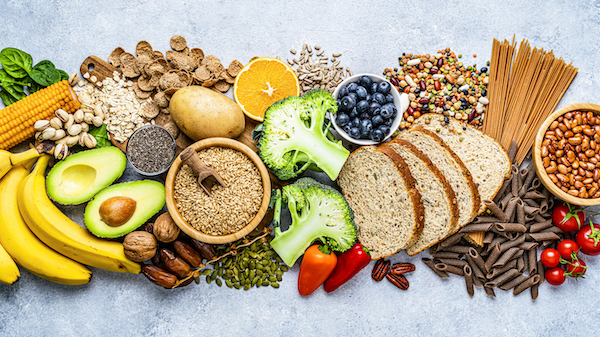
Complex carbohydrates are at the opposite end of the spectrum with foods like vegetables, fruits, whole grains, legumes and nuts. Complex carbohydrates are good for us and here’s why:
- They are typically rich in fiber and micronutrients.
- Their added nutrition takes longer to digest, and slows the break-down process. This helps maintain healthier insulin and blood sugar levels, which lowers the risk for insulin resistance and keeps moods more stable.
- Their slower rate of sugar absorption provides a steadier supply of energy so less sugar is stored in the liver and as fat.
- They satisfy hunger better and for longer periods, decreasing sugar spikes and crashes. They also help prevent the vicious cycle of cravings you get with simple carbohydrates.
Why are the glycemic index and glycemic load so important?
The glycemic index (GI) ranks foods numerically according how they can increase blood sugar and insulin levels. Foods with a high GI increase blood sugar more rapidly than low-GI-foods.
Even more important — and more practical — is the glycemic load (GL) of a food. That’s because the glycemic load factors serving size into the equation, as well as protein and fat content. With that information, you have a better sense of how much sugar your cells will have to take in, and how fast they have to do it, when you eat that food.
The glycemic load is more about the impact of the food on your body than a “how much” measurement. It covers more of the bases because it rates how much and what kind of carbohydrate is present in the food as well as how much of it you consume.
Here’s an example: carrots and plain macaroni have the same GI, but they don’t have the same GL. Macaroni contains mainly refined, starchy carbohydrates that break down quickly. Carrots have complex carbs that break down slowly, along with higher fiber content, which also affects how quickly the carbs break down.
Carrots are also rich in vitamins and antioxidants. You can eat portions of both foods with the same amount of carbs but you won’t get the same release of insulin. Carrots just don’t break down as quickly as macaroni, so eating them doesn’t flood your body with glucose.
Carbs that quickly break down cause a rapid spike of glucose into the bloodstream, which in turn sends insulin surging upwards. The higher and more often your insulin levels spike, the more likely your cells are to become resistant to its action. So the higher the GL of a food, the likelier it is to cause insulin spikes and the more potential it has to affect your metabolism.
Knowing more about glycemic index and glycemic load can help you make realistic choices about what to eat, and when you should eat it in order to maintain a healthy insulin response.

How can you make good carbohydrate decisions?
It’s important for women to understand that they shouldn’t cut out all carbohydrates just because of a high GI. We all need carbohydrates to stay well and fuel brain function.
Choose carbs that:
1. satisfy your hunger.
2. meet your desire to eat something tasty.
3. provide real nutrition.
This basic chart gives you a rough idea how different foods affect blood sugar. We recommend looking for unprocessed foods that are naturally rich in nutrients. And portion size does matter. You can eat lots of slower-acting carbs to satisfy hunger or choose small amounts of fast-acting carbs occasionally when you want a little taste of something sweet.
| Fast-acting carbohydrates | Intermediate-acting carbohydrates | Slower-acting carbohydrates |
|---|---|---|
| Cookies Cakes White bread White pasta Sugar cereals Juice Alcohol |
Fruits White potatoes Sweet potatoes Carrots Beets Winter squash |
Whole brown rice Quinoa Millet Sprouted grains Other whole grains Milk Nuts |
At Women’s Health Network, we like to follow the “85-15” guideline. Eat a nutritious and balanced diet 85% of the time and the other 15% is up to you. When you do decide to indulge follow these tips to prevent a carb crash:
- Pair your treat with some protein and a little fat to slow down digestion and lower the insulin spike.
- Consider flourless recipes for baking.
- Treat yourself with 1-2 ounces of dark chocolate with 60% cacao or higher.
- Take the time to slow down and enjoy your sweet treat, whatever you choose.
- Have a tall glass of water with a slice of lime or lemon before and after your treat. This can help tamp down, or eliminate, your carb cravings.
- If you’re already insulin resistant, all carbs may cause trouble so make sure you choose wisely.
Make friends with carbohydrates for better health and more happiness
Your body needs the information contained in complex carbs for health and proper insulin sensitivity. Otherwise, you may be creating conditions that accelerate disease processes. Complex carbohydrates, with their macronutrients and micronutrients offer the slow-burning fuel that allows you to feel satisfied while helping your body regulate insulin production and release.
Simple carbohydrates are desirable for a reason, and, we have to make the decision that’s right for us in the moment. Too much sugar on a regular basis can cause rollercoaster moods, energy crashes and hard-to-manage cravings.
That’s why balance is best. Treat yourself every now and then but don’t let carbohydrates get you down.
1 [No author listed.] 200_. The human brain. URL: https://www.fi.edu/learn/brain/carbs.html (accessed 11.19.2008).
2 Barclay, A., et al. 2008. Glycemic index, glycemic load, and chronic disease risk — a meta-analysis of observational studies. Am. J. Clin. Nutr., 87 (3), 627–637. URL (abstract): https://www.ncbi.nlm.nih.gov/pubmed/18326601 (accessed 09.26.2008).
See also:
Mendosa, D. 2008. Glycemic index and glycemic load. URL: https://www.mendosa.com/gilists.htm (accessed 11.13.2008).
Mendosa, D. 2003. Glycemic values of common American foods. URL: https://www.mendosa.com/common_foods.htm (accessed 11.13.2008).
3 Liang, B. 2003. Biomolecules — the carbohydrates. URL: https://www.wisc-online.com/objects/index_tj.asp?objID=AP13104 (accessed 10.01.2008).