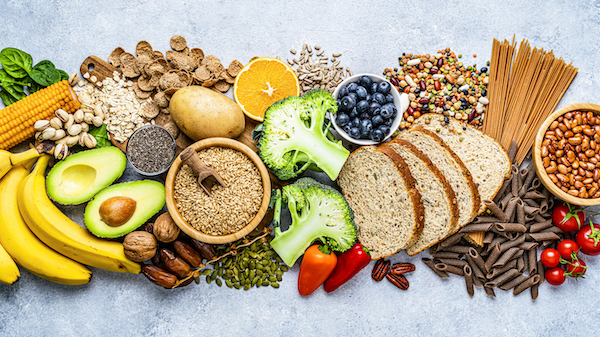



Why are we suddenly seeing and hearing so much about gluten? It’s become a major selling point on many of the foods we see at the grocery store. Gluten sensitivity is also a popular topic in health magazines, in journals, and on-line. To answer our questions, it helps to understand where gluten comes from.

Gluten is the substance that gives dough its elasticity and makes pasta and bread chewy. Along with starch, gluten resides in the endosperm of seeds in the grass family (grains), where their purpose is to nourish the growing seedling as it sprouts. Unlike starch, which is pure carbohydrate, gluten is made up of glycoproteins — that is, sugars combined with proteins — mainly gliadins and glutenins, which come in a range of shapes and sizes themselves.
Because of their unique glycoprotein content, some grains are more problematic than others. Different grain species, subspecies, and varieties contain varying proportions of glutenins and gliadins, with members of the wheat tribe containing the most.
Grains and gluten and members of the wheat tribe
Gluten proteins occur naturally in many grass species, but especially those of the wheat “tribe.” This includes wheat species in all their various forms — durum, semolina, spelt, kamut, triticale, einkorn, emmer, graham, malt, couscous, seitan, bulgur, and faro — plus wheat’s first cousins, rye and barley.
Oats are a second cousin to wheat, and they may also contain gluten proteins, but generally in much lower amounts and more often as a result of cross-contamination in growing, storage or processing.
More distant cousins to wheat are rice, corn, millet and sorghum, whose kernels contain disease-activating proteins in varying, generally small amounts in their natural state. They too can become contaminated, however, both pre or post harvest.
Buckwheat and quinoa are not true grasses but amaranths, like rhubarb, and are naturally gluten-free. As long as they’re grown in fields that aren’t rotated with true grains and processed in dedicated facilities, they can be safely included in a gluten-free diet.
It’s thought that the gliadins are mostly responsible for triggering the immune response associated with gluten intolerance and its more serious form, celiac disease, while the glutenins aid and abet the process by amplifying inflammation.
But the molecular underpinnings of gluten-related disorders are complex, interrelated, and confounding. We don’t fully understand why so many people are sensitive to gluten these days, but there are many different theories. A hundred years ago, the crops in our fields were not only more richly varied, but foods were grown and stored in smaller quantities. Within a span of mere decades Americans have come to consume a fifth of their calories in the form of bleached, refined wheat flour derived from just two species! Meanwhile, we’ve become more of a melting pot than ever, so it stands to reason our wheat-heavy diet might offend our genetic ancestry. It could be that because we’re no longer consuming the same grains and varieties our ancestors did, our bodies register those we do consume as “foreign.” Another possible source of our sensitivity is that we’re now cultivating so few varieties of wheat in huge tracts, spraying it with pesticides, and storing it in enormous silos that could be harboring molds and other toxins. Could it also be that we are reacting to genetically-modified wheat?
Sadly, we don’t have clear answers yet. Agronomists are looking for the “least toxic” cereals, but it’s like finding a needle in a haystack to come up with varieties that possess all the delightful baking qualities of glutenins and gliadins without their harmful effects! Meanwhile, gluten is becoming more and more of an issue in our modern society, and it affects much more of the body than you may think. We often recommend that women try a gluten-free diet if they have stubborn symptoms, even when there’s no obvious connection between what they eat and how they feel — and many women are surprised to find they feel better fairly quickly! Find out more about gluten sensitivity in our article on celiac disease and gluten intolerance.
1 Helms, S. 2005. Celiac disease and gluten-associated diseases. Alt. Med. Rev., 10 (3), 172-192. URL (PDF): https://www.thorne.com/media/Celiac.pdf (accessed 11.15.2008).
2 Levin, B. 1999. Environmental Nutrition: Understanding the Link between Environment, Food Quality, and Disease, 47. Vashon Island, WA: Hingepin.
3 Craig, D., et al. 2007. Advances in celiac disease. Curr. Opin. Gastroenterol., 23 (2), 142-148 URL: https://bcbsma.medscape.com/viewarticle/551791_10 (accessed 11.14.2008).
Howdle, P. 2006. Gliadin, glutenin or both? The search for the Holy Grail in coeliac disease. Eur. J. Gastroenterol. Hepatol., 18, 703–706. URL (abstract): https://www.ncbi.nlm.nih.gov/pubmed/16772825 (accessed 11.15.2008).
Londei, M., et al. 2005. A search for the Holy Grail: Non-toxic gluten for celiac patients. Gastroenterol., 129 (3), 1111–1113.
See also:
- Kagnoff, M. 2005. Overview of pathogenesis of celiac disease. Gastroenterol., 128 (4 Suppl. 1), 510–518.
- Celiac Sprue Association. Gluten-free diet: Grains and flours. URL: https://www.csaceliacs.org/gluten_grains.php (accessed 11.15.2008).