



Are multivitamins safe to take?
Yes, it is safe to take a daily multivitamin, according to Harvard’s School of Public Health (HSPH), contrary to some recent reports. What’s more, HSPH says that taking a multivitamin/multimineral supplement “offers safe, simple micronutrient insurance.”

HSPC blames the confusion on grave flaws in numerous multivitamin studies with negative conclusions. HSPH says many study participants were already seriously ill before entering the studies. Another major problem is the inability to accurately compare the different supplement types and amounts used by participants. And study participants took their separate products for different periods of time — not very scientific!
HSPH says, though we’re still learning about optimal nutrient intake, “the potential health benefits of taking a standard daily multivitamin appear to outweigh the potential risks for most people.”
Source: The Harvard T.H. Chan School of Public Health
Do you wonder if you should be taking a multivitamin every day? Most of us already know that we need certain raw materials in consistent amounts to fuel all of our biological mechanisms. This never-ending nutritional requirement becomes more critical as you go through life.
Essential nutrition includes macronutrients — protein, carbohydrates and fat — that you get from food. It also includes micronutrients — vitamins and minerals — as well as essential fatty acids (EFAs). Since your body can’t make EFAs on its own, you have to get them from foods such as fish. In the case of omega-3 EFAs, it might be a challenge to eat enough fish to get an adequate supply every day.
It’s hard to get micronutrients from food alone
Only in theory can the food you eat supply the amounts of micronutrients your body needs daily. Much of our standard diet is “micronutrient-poor” and is missing many — or all — of the essential vitamins and minerals. Often, micronutrients are processed right out of foods when manufacturers and chain restaurants produce convenience meals and fast foods.
Over recent decades, changes to the way foods are grown and raised have reduced micronutrient content. You can also miss out on key nutrition if you’re trying to lose weight by restricting certain foods or by skipping breakfast or lunch. But since our bodies still need these essential nutrients, many of us turn to vitamins.
Without enough essential vitamins and minerals your body struggles to keep up
Even though the micronutrient amounts you need are tiny, when you don’t get enough of each every day, your body will let you know. Whether it’s in the form of illness, reduced or altered immune function, or worse, micronutrient deficiencies are a real threat to your health.
Around the world, deficiencies of commonly available vitamins and minerals continue to jeopardize the health of countless people, especially children whose bodies and brains are still developing. But even in the US, plenty of women are not getting important nutrients every day. They may simply not be eating right or could have problems absorbing specific nutrients.
Every essential nutrient has a vital task and each one usually works with another — or several others. For example, Vitamin E works better alongside Vitamin C. Calcium is absorbed much better when taken with magnesium. That’s why the best multivitamins are comprehensive and formulated to ensure you benefit from the synergistic effect of all the nutrients working together.
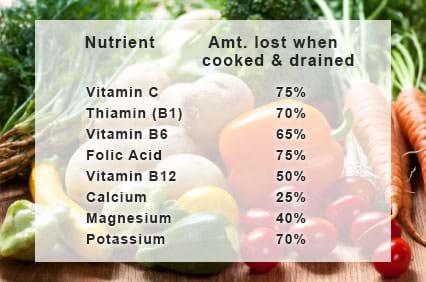
Raw vs. cooked
Lots of foods are naturally packed with key nutrition but many nutrients are lost on the way to the dinner table.
Are the Recommended Dietary Allowances enough?
Recommended Dietary Allowances (RDAs) for vitamins and minerals were created after WWII to prevent extreme diseases like scurvy and rickets. But RDAs were meant to be bare minimums, not optimal dosages. That’s why RDAs are not a good guide today for women who want to use supplemental nutrition for wellness and disease prevention.
One thing we do know: significantly higher doses of vitamins and minerals are needed for optimal health than what is recommended in the RDAs. A study in the Journal of the American Medical Association set therapeutic dosages many times higher than the RDAs. While the guidance on micronutrient dosing is still evolving, we recommend a conservative but therapeutic dose based on the latest nutritional science — not too much, but enough.
The best women’s multivitamin — qualities to look for
Deciding on a brand of multivitamin can be overwhelming due to the wide range of choices available at the store and online. To narrow your search, look for these important features:
1. Complete and natural. Based on the latest nutritional science, women need at least 30 essential vitamins and minerals. Look for multivitamins without artificial preservatives, dyes, sweeteners or other contaminants.
2. Bioavailable. ”Bioavailability” measures what’s truly absorbed by the body. To ensure nutrients get through the digestive tract, high-quality vitamins are tied to another molecule — or chelated — so they move into the bloodstream where they can be absorbed. The best have minimal processing because over-processing can destroy the ingredients’ nutritional value.
3. Manufactured safely, laboratory-tested and guaranteed. Like pharmaceutical drugs, every batch of a nutritional supplement should be tested in a laboratory to ensure it contains exactly what’s on its label. Look for vitamins that are manufactured in a facility validated by NSF International (National Sanitation Foundation) to meet or exceed government requirements for the FDA’s Good Manufacturing Practices (GMPs). And buy from a company that guarantees your satisfaction with its products.
4. Makes a difference. If your nutritional supplement doesn’t make you feel better within the first 30-60 days, try a different one. Your symptoms may not be fully resolved during that time, but you should feel a real improvement.

If you’ve tried a multivitamin before without positive results, it’s probably because you took ordinary vitamins that didn’t have the full range of necessary nutrients. Or, you may have chosen a low-priced or discount vitamin that’s cheaper because it contains nutrient forms that aren’t very absorbable. One common issue: you may not have taken your multivitamin regularly simply because you forgot to.
People who take multivitamins are generally healthier and tend to lead wellness-supporting lifestyles. When you take a multivitamin, try to make a habit of it so your body gets the essential micronutrients in consistent amounts every day. You’ll like the way you feel.
https://www.everydayhealth.com/womens-health/vitamins-for-women/ https://www.mensjournal.com/health-fitness/nutrition/joel-fuhrmans-micronutrient-diet-20130403
https://www.livestrong.com/article/324105-what-nutrients-are-lacking-in-fast-foods/
Journal of the International Society of Sports Nutrition 20107:24. https://jissn.biomedcentral.com/articles/10.1186/1550-2783-7-24.
Accessed 5.03.16 J Acad Nutr Diet. 2016 Apr;116(4):667-676.e6. doi: 10.1016/j.jand.2015.12.021.
https://www.ncbi.nlm.nih.gov/pubmed/26899193. Accessed 5.03.16 https://www.cdc.gov/immpact/micronutrients/
https://www.who.int/nutrition/topics/vad/en/ https://www.crnusa.org/benefits/files/04CRN-BenefitsBook-whouses.pdf