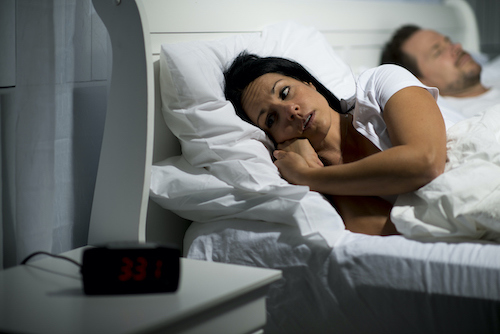



If you’re tackling insomnia — with or without a doctor’s help — and still aren’t sleeping, there are many alternative behavioral treatments to try. Insomnia is deeply personal and it may take some exploration to find what works for you.

Many behavioral approaches to insomnia (including cognitive behavioral therapy, sleep restriction therapy, light therapy and acupuncture) are best implemented under the guidance of a trained sleep clinician or therapist.
For most people, these methods aren’t time-consuming or costly, and they’re much better for your long-term health than any prescription sleep medication.
Cognitive Behavioral Therapy (CBT)
Changing your attitude about sleeping may be the best way to develop long-term, positive sleeping patterns. With CBT, a therapist or practitioner helps the patient identify and correct distorted or maladaptive beliefs. One premise of cognitive therapy holds that merely thinking about sleeplessness and the problems it causes leads to ongoing insomnia, the proverbial vicious cycle.
CBT can teach a person how to develop a more positive outlook on sleep, while simultaneously encouraging better behaviors that are more conducive to having restful sleep. This good “sleep hygiene” includes turning off the TV well before bedtime, and only using your bed for sleeping or sex.
Many clinicians may think that behavioral therapy is cumbersome and for them, compared to writing a prescription, it is. However, studies show that it works well. In a comprehensive review of 37 insomnia treatment studies on over 2000 people, behavioral approaches such as cognitive behavioral therapy (CBT) and relaxation training were much more successful than medication, for both primary insomnia and secondary insomnia. In fact, the American Academy of Sleep Medicine practice guidelines suggest using behavioral therapy as first-line treatment for insomnia.
To learn more about CBT or to find a trained therapist, visit National Association of Cognitive Behavioral Therapists or the American Institute for Cognitive Therapy.
Sleep Restriction Therapy (SRT)
With sleep restriction therapy (SRT), the goal is to find your body’s ideal threshold for sleep — whether it’s five hours or nine hours. SRT also aims to reduce the amount of time you spend lying in bed trying to drop off. Sleep experts think this makes insomnia even worse. The idea is to gradually adjust your sleeping time until you reach your personal sleep threshold, and eventually, feel well rested every morning. In one form of SRT, you don’t allow yourself sleep for at least 24 hours or until your body is begging for a snooze. Once you get to sleep, you make yourself get up sooner than you’d like, day after day, until exhaustion sets in at night and you fall asleep easily and rest soundly.
In another variation of SRT, you might keep a sleep log for a couple of weeks and a sleep clinician estimates your “sleep efficiency” or the time you spent asleep divided by the time you spent in bed. Then you’re given a prescription for a certain number of hours to spend in bed, while continuing to monitor your sleep efficiency. After that, the prescribed time in bed is extended or decreased by quarter-hour intervals until you reach maximal sleep efficiency.
Though these methods may seem severe, life without sleep is even more troublesome. If SRT sounds interesting to you, consider asking your healthcare practitioner for a referral to a sleep lab to find a treatment course designed for your particular needs.
Light therapy
Light therapy, or phototherapy, works to improve sleep by exposing patients to specific wavelengths of light for a set amount of time. It has been used for seasonal affective disorder, depression, sleep disorders and even skin issues. Melatonin, the key sleep hormone involved in circadian rhythm, is affected by light.
With abnormal light exposure (ex. working the night shift), or changes in seasons, the release of melatonin can be delayed, which can then delay the onset of sleep. Using light therapy in the morning can help reset your internal clock to promote the appropriate release of melatonin and, subsequently, sleep itself.

This type of therapy may work for you because light has a dramatic effect on our circadian rhythm. Exposure to visible, direct intense light or sunlight before trying to go to sleep can make your body think it should stay awake. Alternately, sunlight streaming through the window in the morning signals your brain that it’s time to wake up. Even a very small amount of light in the middle of the night is likely to alter your circadian clock.
Progressive muscle relaxation
Progressive muscle relaxation helps with certain forms of pain, high blood pressure and insomnia, based on the theory that relaxing the body will relax the mind. Starting from the outer extremities and progressively moving toward the face, you purposely and alternately tense and relax muscle groups one at a time to reach a state of deep relaxation.
You can practice tensing and relaxing the muscles one area at a time to recognize how each sensation feels. Try it when you lie down to go to sleep, and you may be able to bring your muscles to rest while your overwrought mind drifts off.
Directed imagery
Directed imagery is a mind-body technique that aims to restore your sense of power and control. When you feel out of control in daily life you may also feel that way when it comes to getting to sleep. When many people lie down to sleep, they end up thinking about stressful events that occurred during the day. Worrying about these problems in bed can make you feel as if you have even less power over them than when you’re awake.
With directed imagery, you perform a specific mental task that can be solved easily prior to or at bedtime. The completion of the task helps you feel more in control and can distract you enough to allow you to fall asleep. Directed imagery can be an emotionally satisfying treatment for people with insomnia that seems to be caused by lots of anxiety. You can learn more about it here.
Emotional Freedom Technique (EFT) and acupuncture
Many times sleeplessness can stem from emotional turmoil, which blocks energy flow over time. Both EFT and acupuncture are used to treat insomnia by acting on pressure points to unblock energy channels in the body and restore positive energy flow. Acupuncture uses thin needles to open energy lines, while EFT can be done with your fingers. These techniques can reduce anxiety and help you sleep by opening your energy channels.

Meditation
Meditating can help rid your mind of the events that took place during your day and clear your head for sleep. You can practice meditation anywhere, though when you’re learning, it helps to be in a quiet environment. By quieting the nervous system, Transcendental Meditation has shown positive results in treating insomnia. And those who meditate get more quality sleep and feel more alert during the day.
To help with sleep, meditation can be practiced while sitting comfortably for 15–20 minutes, two times per day in a quiet place. Beginners can practice focusing the mind on their breathing. When thoughts enter your head and start to distract you— which they will — acknowledge them and move your focus back to the in-and-out of your breathing. When performed in bed, even a few minutes of this process can have dramatic effects on your ability to fall asleep.
Writing it out
Keeping a journal can help you get at the root of insomnia as well. Set a time every day to write down whatever comes into your mind, without worrying about complete sentences or making sense. This stream-of-consciousness writing can help access emotional or psychological issues buried beneath the surface.
Journaling can help you process and resolve these issues by literally taking them from your mind to the piece of paper. Meditative writing helps clear the mental clutter in your brain and can be very revealing.
Help yourself get back to sleep naturally
All of the above methods can help resolve your insomnia, no matter how entrenched it may seem. You do have to be open to trying something different, but the reward of a good night’s sleep will be worth it. For alternative natural supplement options for sleep, see our article Nature’s sleeping aids.
1 Morgenthaler, T., et al. 2006. Practice parameters for the psychological and behavioral treatment of insomnia: An update. An American Academy of Sleep Medicine report. Sleep, 29 (11), 1415–1419.
Sivertsen, B., et al. 2006. Cognitive behavioral therapy vs. zopiclone for treatment of chronic primary insomnia in older adults. JAMA, 295, 2851–2858.
Barclay, L., & Lie, D. 2006. Cognitive behavioral therapy better than Zopiclone for chronic insomnia. URL: https://www.medscape.com/viewarticle/537419 (accessed 12.27.2006. Free access with registration).
2 Keller, D. 2006. ACP: Insomnia responds to behavioral and pharmocologic therapies. URL: https://www.medpagetoday.com/tbprint.cfm?tbid=3774 (accessed 01.02.2007).
3 Wikipedia. 2007. Light therapy. URL: https://en.wikipedia.org/wiki/Light_therapy (accessed 01.02.2007).
4 Raloff, Janet. 2006. Light impacts: Hue and timing determine whether rays are beneficial or detrimental. Science news online, 169 (21), 330. URL: https://www.sciencenews.org/articles/20060527/bob9.asp (accessed 01.02.2007).
5 Stoppler, M., & Shiel, W. 2005. Progressive muscle relaxation for stress and insomnia. MedicineNet. URL: https://www.medicinenet.com/script/main/art.asp?articlekey=47281&page=1 (accessed 01.02.2007).
6 Brooks, J., & Scarano, T. 1985. Transcendental Meditation in the treatment of post-Vietnam adjustment. J. Counseling & Devt., 64, 212–215.
Maharishi University of Managment. Decreased insomnia. URL: https://www.mum.edu/tm_research/h8.html (accessed 01.02.2007).
7 Holistic online. Alternative and integral therapies for insomnia. URL: https://www.holisticonline.com/Remedies/Sleep/sleep_ins_meditation.htm (accessed 1.2.2007).
Further Resources
We have seen good results with an audio CD/MP-3 program called CBT for Insomnia.